
Inositol Powder 2026: The Quiet Ingredient Powering the Women’s‑Health and GLP‑1 Boom
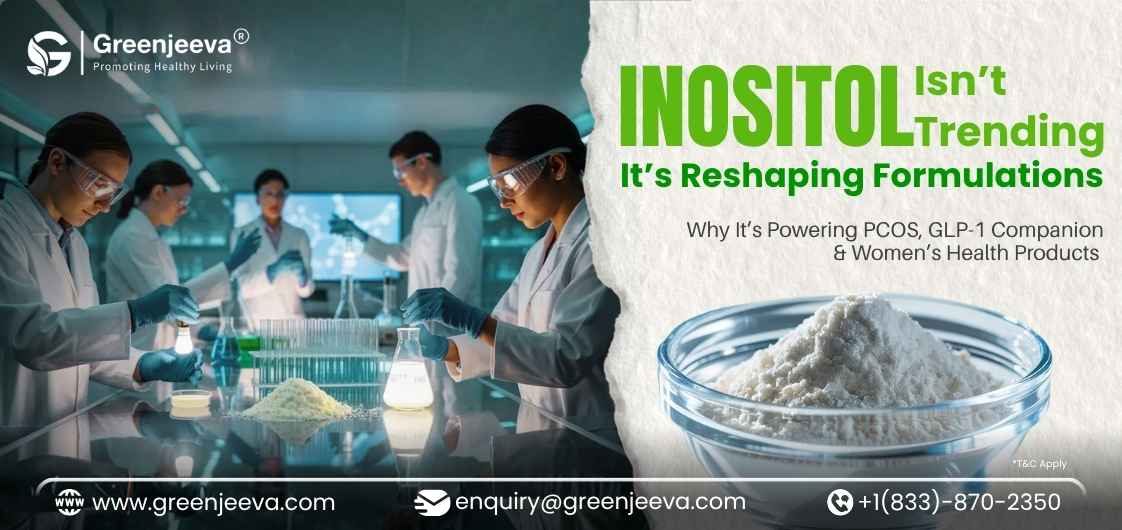
If You’re Not Watching Inositol Powder in 2026, You’re Missing the Shift
New market data suggests that inositol powder is no longer operating as a niche ingredient inside a small corner of the supplement industry. It is now moving into the center of several fast-expanding nutraceutical and functional-food categories.
Globally, the inositol market is projected to grow steadily through the early 2030s, driven largely by increasing demand across dietary supplements, women’s health formulations, metabolic-health products, and functional wellness systems. The strongest momentum is currently coming from three overlapping categories: PCOS-support supplements, metabolic-health products influenced by the GLP-1 boom, and functional food and beverage formulations designed around long-term wellness positioning.
For brands operating in these spaces, the shift is significant.
In women’s health and PCOS-support supplements, growing clinical awareness around myo-inositol powder has accelerated interest in formulations linked to menstrual regularity, insulin sensitivity, ovarian function, and hormone balance. At the same time, the rapid rise of GLP-1-related conversations has pushed brands to rethink how metabolic-support products are positioned. Instead of relying on single-ingredient stories, companies are now building broader “metabolic ecosystem” formulations—and inositol is increasingly becoming part of that strategy.
Functional foods and beverages are evolving as well. Inositol is now appearing in drink mixes, wellness powders, daily metabolic-support blends, and cognitive-health formulations where consumers are looking for ingredients that feel clinically credible yet easy to integrate into everyday routines.
On the surface, inositol still looks like a simple white powder. In practice, however, it has become one of the more strategically positioned ingredients in modern women’s-health and metabolic-health product development.
Why Inositol Powder Is Suddenly Everywhere in 2026
Inositol itself is not new. Clinicians and formulators have worked with myo-inositol powder for decades in products targeting ovarian function, insulin sensitivity, glucose metabolism, and hormone-related wellness support.
What has changed is not the ingredient itself, but the way brands are building products around it.
Today, inositol is increasingly being integrated into:
• PCOS-support supplements built around myo-inositol and D-chiro-inositol ratios
• Hormone-balance and metabolic-health SKUs
• GLP-1 companion supplement positioning
• Functional powders, drink mixes, and wellness formulations
This shift is also reflected in sourcing activity, with inositol powder bulk demand continuing to rise across nutraceutical, women’s-health, and functional-food categories. What was once treated as a niche specialty ingredient is now becoming part of mainstream product strategy.
Inositol isn’t trending because it’s new.
It’s trending because brands are finally using it differently.
Three 2026 Trends Driving Inositol Demand
1. PCOS-Support and Hormone-Balance Positioning
Consumer demand for non-pharmaceutical support products has grown rapidly, particularly in women’s health categories focused on hormone balance and metabolic wellness. Myo-inositol is now widely associated with formulations that support insulin sensitivity, ovarian function, and menstrual regulation, making it a core ingredient in many PCOS-support products.
For many supplement brands, inositol powder bulk is no longer treated as a secondary addition. It is increasingly positioned as a primary active inside hormone-balance and reproductive-health formulations.
2. Women’s Health as a Growth Engine
Women’s health supplements continue to be one of the fastest-growing areas in nutraceutical development. Brands are building around concepts such as metabolic support, hormone-friendly positioning, and insulin-sensitizing ingredient systems, especially in categories connected to long-term wellness and lifestyle management.
This is where inositol powder bulk formulations fit naturally. The ingredient aligns with multiple high-growth narratives simultaneously, which is one reason it has become increasingly attractive to both established nutraceutical companies and emerging wellness brands.
3. GLP-1 Companion and Metabolic Positioning
The rise of GLP-1 medications has significantly changed how consumers think about metabolism, appetite management, and long-term wellness support. As a result, supplement brands are now creating broader support ecosystems around metabolic health rather than focusing on isolated claims.
This has created a new positioning space for inositol.
Rather than competing with GLP-1 medications, inositol is increasingly being incorporated into “GLP-1 companion” formulations and metabolic-support systems designed around insulin signaling, glucose metabolism, and lifestyle support.
The opportunity is not about replacing GLP-1.
It’s about building around the metabolic ecosystem surrounding it.

Inositol Powder Basics
Inositol belongs to a family of cyclohexane-based sugar alcohols, but in formulation work, two forms dominate most product development discussions: myo-inositol and D-chiro-inositol.
Myo-Inositol
Myo-inositol is the primary form used in women’s-health and metabolic formulations. It is widely associated with insulin signaling, hormone balance, ovarian function, and PCOS-support protocols.

D-Chiro-Inositol
D-chiro-inositol plays a more targeted role in glucose metabolism and glycogen-related pathways. It is typically used in smaller quantities alongside myo-inositol.
Most modern formulations now use a 40:1 myo-to-D-chiro ratio, reflecting physiological balance and formulation trends driven by PCOS-related research.
What Is the Difference Between Myo-Inositol and D-Chiro-Inositol?
Myo-inositol primarily supports cellular signaling and hormone-related pathways, while D-chiro-inositol is more closely associated with glucose metabolism. In formulation systems, the two are often combined in carefully defined ratios to support metabolic and hormone-balance positioning.
Where Inositol Fits in Modern Product Development
One reason inositol has become strategically important is its flexibility across multiple product categories.
In women’s-health formulations, it is commonly used in PCOS-support products, hormone-balance supplements, and reproductive-health systems. In metabolic-health products, it is associated with insulin signaling and glucose-management positioning. Functional-food and beverage manufacturers are increasingly incorporating it into drink mixes, wellness powders, and daily-use metabolic-support systems.
It is also becoming more common in GLP-1 companion products positioned around lifestyle support and long-term metabolic wellness.
For formulators, this versatility matters because it allows a single ingredient to participate in multiple high-growth narratives at once.
Where Inositol Formulations Go Wrong
This is where many brands underestimate the ingredient.
At the lab scale, inositol can appear relatively straightforward to formulate with. But once production scales increase, challenges begin to emerge. Common issues include clumping in powder blends, inconsistent solubility in drink systems, dosage variation across batches, and moisture-driven instability during storage or handling.
These problems rarely appear in early-stage R&D.
Most inositol issues don’t show up during formulation.
They show up during scale-up and production consistency.
For contract manufacturers and nutraceutical brands, these variables can directly affect processing efficiency, product uniformity, and long-term stability.
Formulation Considerations for Inositol Powder
For R&D teams working with bulk inositol powder, performance depends on far more than purity alone.
Solubility is one of the ingredient’s major advantages, especially in beverage systems, drink mixes, sachets, and wellness powders. However, moisture sensitivity can create handling and storage challenges if humidity control and packaging systems are not managed correctly.
Compatibility is another advantage. Inositol blends well with vitamins, minerals, botanicals, and a wide range of functional actives, which is why it integrates easily into complex formulations.
Its dosage flexibility also makes it useful across multiple delivery formats, including capsules, powders, stick packs, and functional foods.
Why COA Is Not Enough for Inositol Powder
Most suppliers can provide:
• Similar purity specifications
• Comparable certifications
• Standardized documentation
But documentation alone does not determine how an ingredient behaves in real production systems.
A COA will not show:
• Blending performance
• Solubility consistency
• Satch repeatability
• Compatibility across formulations
This is where sourcing differences become visible.
A compliant batch is not the same as a consistent batch.
For brands scaling women’s-health or metabolic-health formulations, consistency across production runs often matters more than the specification sheet itself.

What Determines Inositol Performance in Real Systems
Several variables influence how inositol powder bulk performs in formulation systems, including:
• Purity level
• Particle size distribution
• Moisture control
• Batch consistency
• Interaction with other active ingredients
Together, these factors determine whether inositol behaves like a reliable formulation ingredient—or introduces variability during scale-up.
How to Choose an Inositol Powder Supplier
When evaluating inositol powder bulk supplier options, procurement and formulation teams should look beyond pricing and documentation alone.
Important considerations include:
• Batch-to-batch consistency
• Purity stability across shipments
• Formulation compatibility
• Documentation readiness, including COA, GMP, NSF, and USDA Organic support where relevant
On paper, many suppliers appear nearly identical. In production, however, differences emerge in flow behavior, solubility consistency, blending performance, and repeatability at scale.
Bulk Inositol Pricing: What Actually Matters
Bulk pricing is influenced by factors such as purity level, sourcing consistency, order volume, and supplier reliability.
But focusing only on cost-per-kilogram can be misleading.
Hidden costs often appear later through:
• Reformulation work
• Batch inconsistency
• Production slowdowns
• Operational inefficiencies
For women’s-health brands, contract manufacturers, and nutraceutical companies, a predictable and reliable inositol powder bulk supplier is often more valuable than the lowest upfront price.
Inositol in 2026: What Actually Matters
As the category evolves, several things are becoming increasingly clear:
• Inositol is now central to PCOS and metabolic-health formulations
• It aligns naturally with GLP-1 companion positioning
• Women’s-health brands are treating it as a core active ingredient
• Sourcing consistency is becoming critical as products scale
What Smart Brands Are Doing Right Now
Leading brands are already responding to these shifts by:
• Launching PCOS-focused SKUs
• Building GLP-1 companion product lines
• Developing private-label inositol supplements
• Positioning around purity, transparency, and formulation consistency
The brands moving early are not just selling ingredients. They are aligning their product strategy with where consumer demand is heading.
Final Takeaway: Inositol Is a Positioning Decision, Not Just an Ingredient
In 2026, inositol powder is no longer simply another formulation component inside the supplement industry. It has become part of a much larger category narrative built around women’s health, hormone balance, metabolic wellness, and GLP-1-adjacent support systems.
The opportunity is not just in adding inositol to a label.
It is in understanding how the ingredient behaves in real formulations, how it scales in production, and how it fits into the next generation of metabolic-health and women’s-health product development.
The brands that win will not just follow the trend.
They will build products around where the category is heading next.