
What Defines Genuine Organic Ashwagandha Root Powder in Bulk Supply?
Ashwagandha powder is everywhere.
It appears in capsules, functional blends, drink mixes, gummies, and an expanding range of stress-support and wellness formulations. The market is crowded, specifications often look similar, and many suppliers claim comparable purity.
Yet experienced buyers know something uncomfortable:
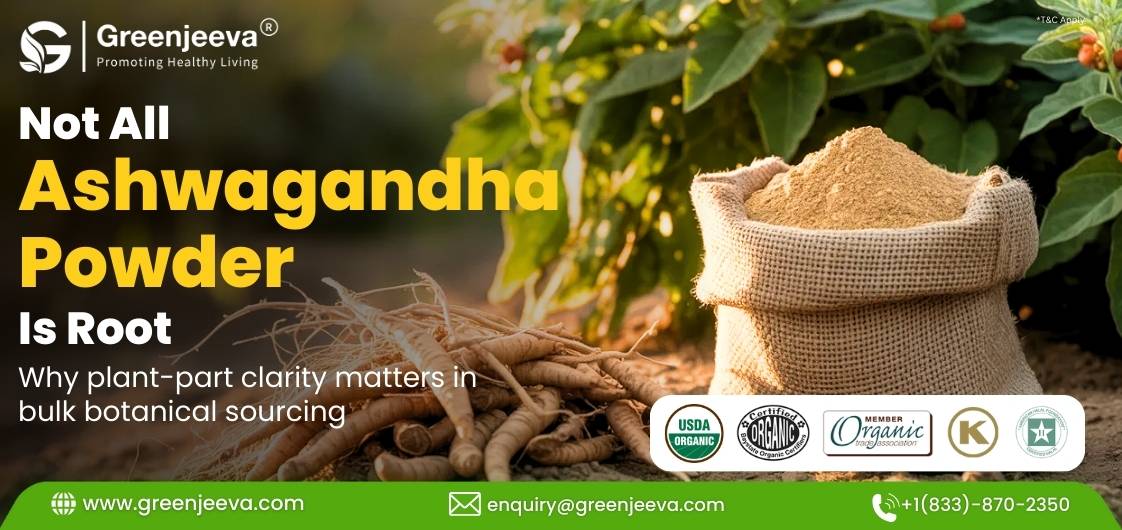
Not every powder sold as ashwagandha is truly root.
And in commercial manufacturing, that distinction matters far more than marketing language.
When “Ashwagandha Powder” Stops Being a Simple Term
In theory, the name seems straightforward.
In practice, ashwagandha powder can represent multiple realities:
- true milled root
- blended plant parts
- extract residues
- materials standardized after processing
Each behaves differently in formulation, documentation review, and long-term supply programs.
This is why procurement and QA teams increasingly ask not only what the ingredient is called, but:
What exactly has been milled, and how is the plant part verified?
The Identity Question Behind Withania somnifera
Most suppliers correctly reference Withania somnifera.
But botanical naming alone does not resolve the issue of identity.
For bulk buyers, authenticity revolves around:
- confirmation of root-only material
- clarity on agricultural origin
- traceability from harvest through milling
- separation from extract streams
Because once material is milled, visual differentiation becomes difficult.
Documentation and sourcing discipline take over.

Why Root vs Extract Confusion Continues
Search behaviour reveals an ongoing overlap between:
- ashwagandha extract powder
- and traditional whole-root formats.
They serve different purposes.
Extracts offer targeted standardization.
Root powder offers a broader botanical matrix and is often preferred in products emphasizing heritage or whole-plant positioning.
Problems arise when expectations from one format are projected onto the other.
That mismatch is where reformulation, relabeling, or regulatory review can start.
What Experienced Buyers Mean by “High Quality”
When professionals search for high quality ashwagandha powder or pure ashwagandha powder, they usually are not asking about color or aroma.
They are asking whether the material can stand up to:
- specification scrutiny
- repeat orders
- audit review
- and scale consistency.
Quality, in this context, means identity integrity.
The Growing Importance of Organic Status
Demand for organic ashwagandha powder continues to rise across U.S. markets.
But certification alone is not the finish line.
Buyers still want confidence that:
- the certified material reflects the intended plant part
- processing has not introduced ambiguity
- documentation aligns with label representation.
Organic claims strengthen positioning.
They do not replace verification.

What Changes When Volumes Increase
Small quantities often pass initial evaluations smoothly.
At larger commercial volumes — whether teams are purchasing ashwagandha in bulk, Bulk Ashwagandha Powder, or ashwagandha powder in bulk— new pressures emerge:
- tighter repeatability expectations
- higher documentation scrutiny
- deeper supplier review
- increased downstream exposure.
At scale, uncertainty that seemed minor becomes operational risk.
How Procurement Teams Evaluate Suppliers Today
Supplier selection for Bulk Organic Ashwagandha Powder is no longer transactional.
Buyers typically investigate:
- traceable sourcing
- clarity on plant part handling
- consistency across harvest cycles
- separation between root material and extract operations.
For many, choosing the right Ashwagandha Powder suppliers less about immediate availability and more about future reliability.
The USA Dimension
Searches such as ashwagandha Powder USA and related supplier terms show another expectation:
proximity to dependable logistics, faster communication cycles, and documentation readiness aligned with domestic manufacturing timelines.
This becomes critical when supply programs run continuously rather than occasionally.
A Practical Reality Most Veterans Accept
The challenge is rarely dramatic fraud.
- More often, it is subtle ambiguity:
- incomplete upstream clarity
- inherited assumptions
- or gaps between agricultural supply and finished powder.
Over time, those gaps surface.
Final Perspective
In modern manufacturing, ashwagandha root powder is evaluated not by what it claims to be, but by how confidently its identity can be defended.
For teams managing risk, scale, and regulatory visibility, that difference is decisive.
If your formulations depend on authentic root material, reviewing how suppliers define and document plant part integrity becomes one of the most important steps in the approval process.