
Your Life science Degree Is Just the Beginning — The Skills You Add to Your CV Define Your Career
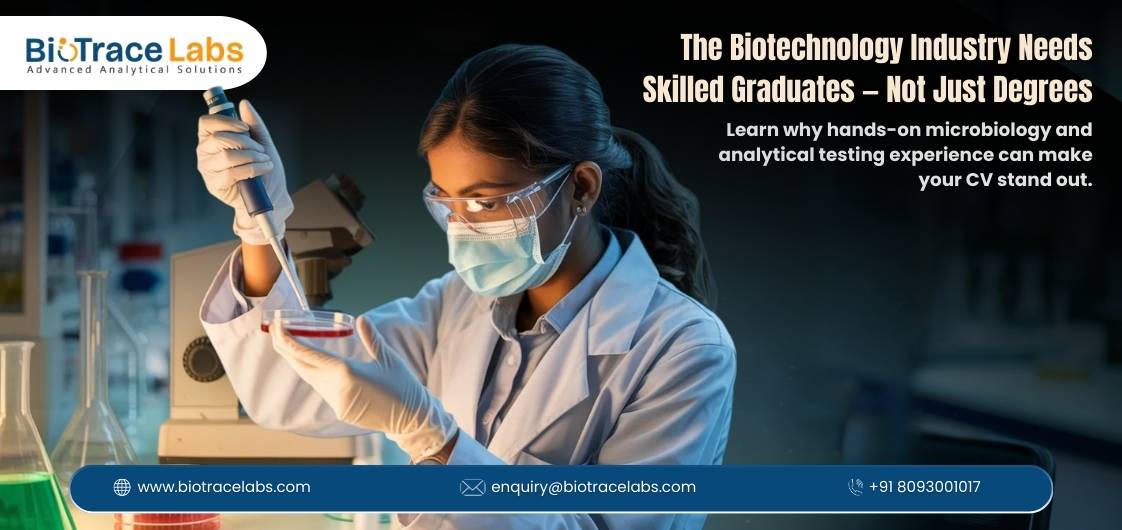
A few weeks after graduation, Riya sat across from an interviewer at a biotechnology company.
Her CV looked impressive — a B.Sc. in Microbiology, strong academic scores, and a list of subjects ranging from microbiology to analytical chemistry.
The interviewer glanced through her resume and asked a simple question:
“Which microbiology techniques have you performed independently in the lab?”
Riya paused.
She remembered learning about microbial culture methods in textbooks. She had seen demonstrations during practical classes. She understood the theory behind analytical instruments, including concepts like uv spectroscopy and basic organic compound analysis.
But when it came to hands-on laboratory experience, she struggled to describe what she had done herself.
That moment is more common than most microbiology students realize.
Every year, thousands of graduates' step into the job market with solid academic knowledge — yet many feel uncertain when interviewers begin asking about real laboratory skills.
And the reason is simple.
In today’s biotechnology, pharmaceutical, and research industries, employers are not just looking for degrees.
They are looking for graduates who already understand how laboratories work.
They want candidates who know how to:
- Handle samples carefully
- Prepare culture media
- Perform microbiological techniques
- Operate basic analytical instruments such as the instrument of uv-visible spectroscopy and tools used in uv-vis spectrophotometer analysis
- Follow laboratory documentation and safety protocols
In other words, they are looking for candidates whose CV reflects practical laboratory experience — not just theoretical knowledge.
This is why many microbiology students are now choosing to strengthen their profiles with hands-on laboratory training in microbiology and analytical testing.
Because when recruiters compare two fresher CVs with similar degrees, the deciding factor is often very clear.
One CV lists only academic coursework.
The other includes real laboratory techniques, practical training, and exposure to industry practices such as chromatography in food testing and phytochemical analysis of plants.
And in most cases, that difference is enough to move one candidate ahead of the other.
For students pursuing biotechnology, microbiology, life sciences, or biochemistry, developing practical laboratory skills can significantly enhance career readiness.
Training programs offered by organizations such as BioTrace Labs help students gain hands-on exposure to microbiology techniques, analytical testing methods like liquid chromatography test, and laboratory workflows — allowing them to add meaningful technical experience to their CV.
Because in the biotechnology industry, the knowledge you gain in the classroom builds your foundation — but the skills you practice in the laboratory often shape your career path.

The Hidden Gap Between Academic Learning and Industry Expectations
Universities provide an essential foundation for life science careers. Students learn core subjects such as microbiology, molecular biology, analytical chemistry, and biotechnology principles, including how to define uv-visible spectroscopy and its applications.
However, academic laboratory sessions often have limitations.
In many cases:
- Practical classes are limited in duration
- Students work in large groups
- Exposure to advanced analytical instruments is minimal
- Experiments follow rigid academic protocols rather than industry workflows
As a result, students may graduate without extensive experience handling real laboratory equipment, preparing samples independently, or following professional testing protocols such as phytochemical analysis of plant extract or phytochemical analysis test methods.
The biotechnology, pharmaceutical, food safety, and environmental testing industries, on the other hand, operate under strict laboratory procedures and regulatory frameworks.
Companies expect entry-level professionals to understand:
- Laboratory workflow and safety practices
- Sample preparation and handling
- Basic analytical testing methods
- Documentation and reporting standards
- Equipment handling and maintenance
For fresh graduates, gaining familiarity with these practices can significantly improve their readiness for professional roles.
Why Hands-On Training Makes a Fresher CV Stand Out
When recruiters review fresher CVs, they often see similar academic qualifications.
Multiple candidates may have the same degree, similar grades, and comparable coursework. What differentiates one candidate from another is practical exposure.
Adding hands-on laboratory training to your CV demonstrates several important qualities.
1. Technical Skill Development
Hands-on training allows students to practice laboratory techniques in a controlled environment.
This may include:
- Microbial culture techniques
- Media preparation and sterilization
- Isolation and identification of microorganisms
- Sample preparation for analytical testing
Getting hands-on experience in microbial analysis and uv-vis spectroscopy quantitative analysis
These are skills that employers value because they reflect practical capability rather than theoretical familiarity.
2. Familiarity With Laboratory Environments
Working inside a professional laboratory environment exposes students to the routines and expectations of the industry.
Students become familiar with:
- Laboratory safety procedures
- Good Laboratory Practices (GLP)
- Instrument calibration basics
- Data recording and documentation
Sample handling protocols, including processes like use of spectrophotometer in water analysis and chromatography food testing
These operational skills are rarely taught in detail during academic coursework but are essential in professional laboratories.
3. Increased Confidence During Interviews
Candidates who have completed hands-on training often perform better during technical interviews.
Instead of explaining concepts from textbooks, they can discuss:
- Experiments they conducted
- Techniques they practiced such as phytochemical analysis of medicinal plants
- Instruments they operated
- Challenges they faced in laboratory work
This level of discussion demonstrates practical understanding and genuine engagement with the field.
Recruiters often recognize this difference immediately.
Key Laboratory Skills That Add Real Value to a Microbiology CV
Students often ask what types of skills are most valuable to include on their CV.
Hands-on training programs typically focus on techniques that are relevant across multiple industries.
Microbiology Techniques
Microbiology remains one of the most fundamental areas of laboratory science.
- Practical skills may include:
- Microbial culture techniques
- Streak plating and colony isolation
- Preparation of culture media
- Sterilization methods
- Microscopic examination
- Microbial identification techniques
These skills are widely used in industries such as pharmaceuticals, food safety testing, environmental monitoring, and healthcare diagnostics.
Analytical Testing Techniques
Analytical testing plays a crucial role in quality control and research.
Students may gain exposure to:
- Spectrophotometry techniques and use of uv-visible spectrophotometer
- Chromatography basics including hands-on training on HPTLC
- Sample preparation methods
- Instrument operation fundamentals
- Data analysis and interpretation
These skills are relevant in sectors such as pharmaceutical manufacturing, chemical analysis, food testing laboratories, and research organizations.
Laboratory Quality and Safety Practices
Modern laboratories operate under strict safety and documentation standards.
Training programs often introduce students to:
- Good Laboratory Practices (GLP)
- Laboratory safety protocols
- Quality control procedures
- Documentation and reporting practices
Understanding these standards prepares students for real laboratory environments where precision and compliance are critical.
Career Opportunities That Value Laboratory Skills
Hands-on laboratory training can help microbiology graduates explore multiple career paths.
Common entry-level roles include:
- Microbiology laboratory assistant
- Quality control analyst
- Analytical testing technician
- Laboratory technician
- Research assistant
- Environmental testing analyst
These roles exist across industries including pharmaceuticals, biotechnology companies, food safety laboratories, environmental monitoring organizations, and contract research facilities.
Having practical experience with laboratory techniques can significantly strengthen applications for these positions.
Choosing the Right Training Program Matters
Not all training programs provide the same value.
Students should look for programs that emphasize practical exposure rather than theoretical lectures.
An effective training program typically includes:
- Training conducted in a real laboratory environment
- Hands-on practice with laboratory instruments
- Guidance from experienced laboratory professionals
- Structured modules covering essential techniques
- Opportunities to perform experiments independently
Programs designed with industry relevance in mind help students build both technical skills and professional confidence.
Building Industry-Ready Skills With BioTrace Labs
For students looking to gain practical laboratory experience, training programs offered by BioTrace Labs focus on bridging the gap between academic knowledge and real-world laboratory work.
The programs are designed to help microbiology and life science students develop hands-on skills in areas such as:
- Microbiology laboratory techniques
- Analytical testing methods including uv vis spectrophotometer analysis and liquid chromatography test
- Sample preparation and laboratory workflows
- Laboratory documentation practices
- Quality and safety procedures
By working in a laboratory environment and practicing essential techniques, students gain exposure that complements their academic learning and enhances their professional readiness.
Such training helps students add meaningful technical skills to their CV while building confidence in laboratory work.

Your Degree Starts the Journey — Skills Shape the Career
A microbiology degree provides the theoretical foundation needed to enter the life sciences industry.
But in a competitive job market, skills often determine how quickly a graduate transitions from student to professional.
Adding hands-on laboratory training to your CV demonstrates initiative, practical ability, and commitment to developing industry-ready expertise.
For biotechnology, microbiology, and life science students, investing time in practical training can make a meaningful difference when applying for internships, entry-level roles, or research opportunities.
The earlier these skills are developed, the stronger the professional profile becomes.
Because in biotechnology careers, what you can do in the laboratory often matters just as much as what you learned in the classroom.

.jpg)