
Organic Parsley Powder for B2B Buyers: What to Know Before You Order in Bulk
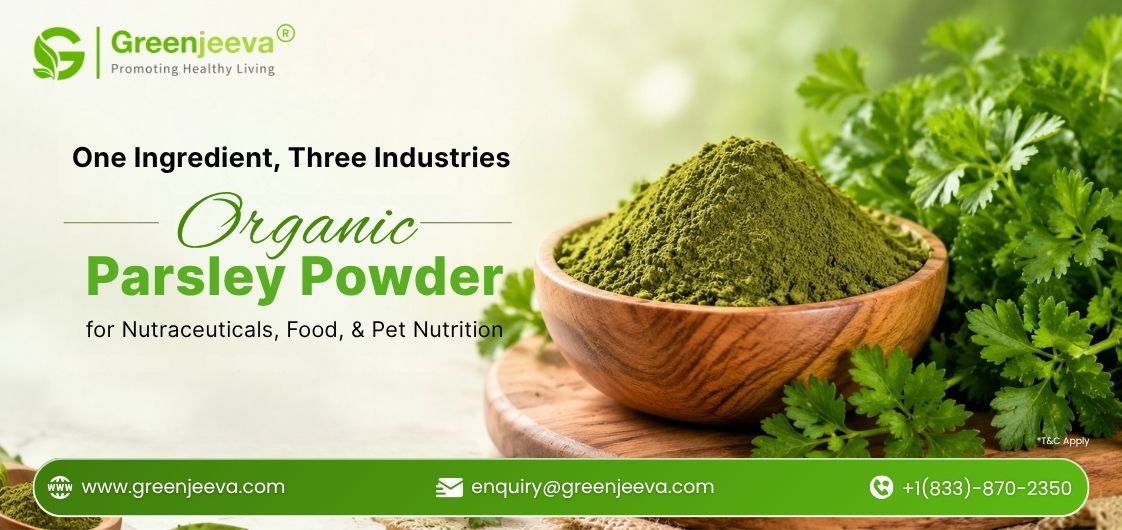
Bulk organic parsley powder has moved from a garnish afterthought to a core ingredient in clean-label supplement and food formulations. Buyers sourcing an organic parsley powder supplier need proof of certification, batch-level testing, and consistent supply, not just marketing claims. This guide covers composition, applications, sourcing criteria, and what to check before you place a wholesale order.
What Is Organic Parsley Powder?
Organic parsley powder is fresh parsley leaf, dehydrated under controlled low-heat conditions and milled into a fine, shelf-stable green powder. A genuine pure parsley powder retains its bright color, mild aroma, and nutrient profile because the drying process is designed to protect chlorophyll and volatile compounds rather than cook them off.
The defining quality marker is certification. USDA Organic parsley powder is grown without synthetic pesticides, herbicides, GMOs, or chemical fertilizers, and the USDA National Organic Program sets the standards that certifying bodies audit against. That certification is not a label for the sake of it. It signals traceability back to a specific farm, documented compliance with agricultural standards, and a lower environmental footprint from the growing process itself.
Nutritionally, parsley powder carries meaningful amounts of vitamin C, chlorophyll (the compound behind its vivid green color), and flavonoids such as apigenin, along with calcium, potassium, and iron. For formulators building green superfood powders or clean-label botanical ingredient blends, that combination of color, mild flavor, and micronutrient content is what makes parsley powder more than a visual filler.
Related reading: Bulk Organic Parsley Powder in Food and Beverage Manufacturing
Formulation Advantages for Nutraceutical Manufacturers
Parsley powder gives formulators a natural green color, a mild herbaceous flavor, and a fine particle size that blends cleanly into capsules, powders, and bars without artificial dyes or flavoring agents.
Color is the first thing buyers notice. Where synthetic dyes read as processed, parsley powder's natural pigment fits directly into the clean-label botanical ingredient story that consumers now expect on supplement labels. Because the flavor is mild rather than dominant, it works as a base note alongside stronger botanicals like turmeric, ginger, or spirulina without masking them.
On the manufacturing side, the powder's fine, consistent particle size supports homogenous blending and reduces clumping in multi-ingredient mixes, which matters for quality control during capsule filling and powder blending runs. This makes it a practical nutraceutical ingredient for teams that need reliable batch-to-batch consistency, not just an appealing story on paper.
Also relevant: Green Superfood Powders: Meeting Demand in the Health and Wellness Market
Core Nutraceutical Applications
Organic parsley powder shows up most often in three product categories: botanical blends, detox and cleanse formulas, and green superfood powders, where its color and mild flavor support the finished product's clean-label positioning.
In botanical blends, parsley pairs with dandelion, nettle, and mint to build nutrient diversity and a recognizable "whole plant" identity that consumers associate with holistic wellness products. In detox and cleanse formulations, its chlorophyll content delivers the vivid green color that visually signals freshness, while its mild flavor balances stronger-tasting ingredients like turmeric. In green superfood blends alongside wheatgrass, spirulina, and moringa, parsley reinforces both color intensity and the overall "green supplement" perception that buyers are formulating toward.
Across all three categories, parsley powder functions as a supporting ingredient that strengthens a formulation's clean-label and plant-forward claims rather than carrying the product on its own.

The Three-Question Test That Separates a Real Supplier From a Risky One
Ask any organic parsley powder supplier three questions before you send a purchase order: can I see the batch-specific COA before I buy, not after; who dried this lot and where; and what happens if a shipment fails your own internal spec. How they answer tells you more than any glossy spec sheet.
"Can I see the COA before I buy?" A supplier confident in their product will send a Certificate of Analysis for the actual lot you are quoting, not a generic template from a past batch. If the answer is "we'll send it after the order ships," that is a lot substitution risk, not a paperwork delay. The COA should cover heavy metals, pesticide residue, microbial load, and moisture content, since moisture above roughly 8 to 10 percent is where shelf stability and mold risk start to creep in.
"Who dried this lot, and where was it grown?" Traceability is not a marketing word, it is a phone call away for a supplier who actually has it. A real answer names the growing region, the harvest window, and the drying method used, because parsley is seasonally harvested and quality shifts noticeably between early and late-season lots. If a supplier cannot answer this without checking with someone else first, they are likely reselling through a broker layer that adds cost and removes accountability.
"What is your process when a batch fails internal spec?" Every supplier occasionally has a lot that does not meet spec. What matters is whether they catch it before it ships. Ask directly what their rejection rate looks like and what they do with a failed batch. A supplier with nothing to say here either is not testing rigorously or is not being straight with you.
Beyond these three questions, confirm organic certification status (USDA Organic or an equivalent recognized body), Kosher and Good Manufacturing Practices (GMP) compliance, and whether capsule-grade or food-grade options are available for your formulation. Ask about minimum order quantity and current lead times too, since drying schedules tighten around harvest season and a supplier who cannot speak to timing in specifics is guessing along with you.

Beyond Nutraceuticals: Food, Pet Nutrition, and Specialty Uses
Outside of supplements, organic parsley powder is used in clean-label seasoning blends, dry soup mixes, plant-based pet supplements, and specialty products like dips and sauces, wherever a natural green color and mild flavor are needed without synthetic additives.
In food manufacturing, it replaces synthetic colorants in ready-to-eat meals and seasoning blends. In pet nutrition, a fast-growing category, it supports botanical-forward treat and supplement formulations for owners who want the same clean-label standards for their pets that they expect for themselves. In specialty food products such as gourmet dips and spice mixes, it adds both flavor and visual appeal.
This cross-category demand is part of a broader shift: the global organic herbs and spices market is projected to grow at a compound annual growth rate of over 9 percent through 2030, according to Verified Market Research, as manufacturers across categories move toward natural, minimally processed ingredients.
How to Buy Organic Parsley Powder Wholesale
Ready to buy bulk organic parsley powder? Request a Certificate of Analysis, confirm your grading requirement (capsule-grade or food-grade), and ask your supplier for current lead times before submitting a purchase order, since seasonal harvest windows affect availability.
Organic parsley powder wholesale pricing varies by grade, certification level, and order volume, so get a quote tied to your specific specification rather than a generic list price. A supplier with consistent inventory and transparent communication about harvest timing will protect your production schedule from unexpected shortages.
Download the COA and full product specification sheet for our organic parsley powder on our b2b platform.
Conclusion
Organic parsley powder has earned its place in nutraceutical formulation through a combination of natural color, mild flavor, and a genuine organic pedigree, but the ingredient is only as good as the supplier behind it. Confirm certification, request batch-level COA testing, and clarify grading and lead times before you commit to a bulk order.
For manufacturers and B2B buyers ready to move forward, download the COA and product specification sheet or register as a buyer to request wholesale pricing.
These statements have not been evaluated by the Food and Drug Administration. This product is not intended to diagnose, treat, cure, or prevent any disease.