

Organic Carrot Granules vs. Carrot Powder: Choosing the Right Ingredient Format for Commercial Food Manufacturing
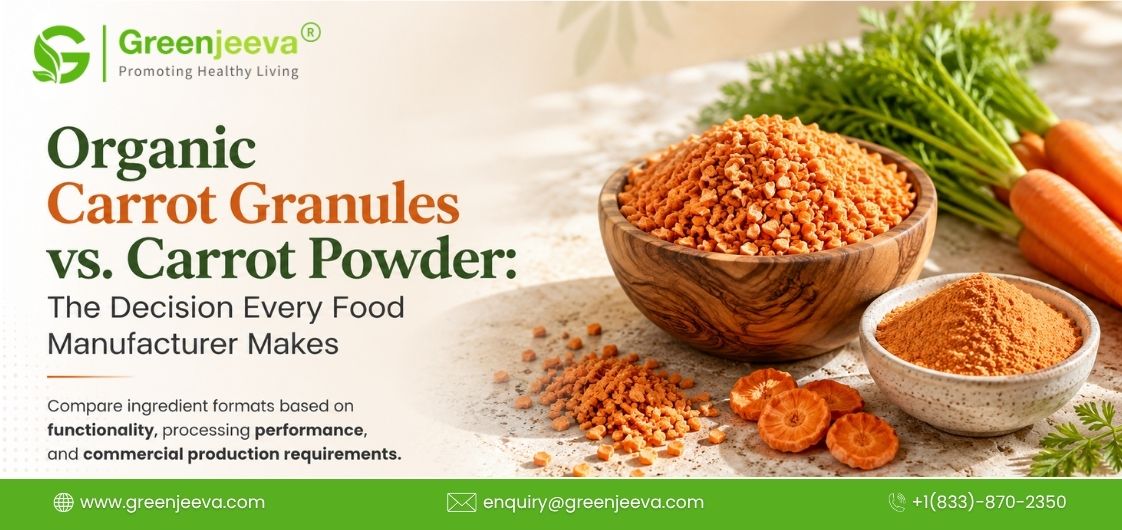
Selecting an ingredient for commercial food production involves more than comparing prices or reviewing a specification sheet. The physical format of an ingredient can significantly influence manufacturing efficiency, product quality, processing consistency, and overall production costs.
This is especially true for carrot-based ingredients.
Although bulk organic carrot granules, carrot powder, and carrot flakes originate from the same raw material, each performs differently throughout the manufacturing process. Factors such as particle size, hydration rate, blending behavior, visual appearance, and handling characteristics all affect how the ingredient behaves during production.
For procurement teams, product developers, and quality professionals, selecting the appropriate format is not simply an ingredient decision it's a manufacturing decision.
This guide explores how bulk organic carrot granules compare with other carrot ingredient formats, the applications where they perform best, and what buyers should evaluate when selecting an organic carrot granules supplier for commercial food manufacturing.
Why Bulk Organic Carrot Granules Are Becoming a Preferred Ingredient for Food Manufacturers
The demand for clean-label, shelf-stable vegetable ingredients continues to grow as manufacturers expand their offerings across soups, ready meals, seasoning blends, snacks, bakery products, and plant-based foods.
In these applications, ingredient functionality often carries greater importance than nutritional composition alone.
Unlike fine powders that disperse quickly or flakes designed for larger inclusions, bulk organic carrot granules provide an effective balance between visibility, handling efficiency, and processing performance.
For many manufacturers, this translates into operational advantages such as:
- Better flow through automated dispensing systems
- Reduced dust generation during production
- Improved ingredient distribution in dry blends
- Enhanced visual appeal in finished products
- Consistent batch-to-batch processing
These functional characteristics explain why many commercial manufacturers choose granules when appearance, blending consistency, and production efficiency are key formulation objectives.
Bulk Organic Carrot Granules vs. Carrot Powder: Which Format Fits Your Manufacturing Process?
One of the most common assumptions in food manufacturing is that finer ingredients automatically perform better.
In reality, the most suitable ingredient format depends on the intended application.
The following comparison highlights how different carrot ingredient formats support different manufacturing requirements.

This comparison illustrates an important procurement principle:
The best-performing ingredient is not always the finest ingredient it is the ingredient best suited to the manufacturing process.
Commercial Applications of Bulk Organic Carrot Granules in Food Manufacturing
Organic carrot granules are widely used across commercial food manufacturing because they provide both functional performance and visual appeal.
Unlike powders that disappear into formulations, granules retain their physical identity, making them particularly valuable in products where visible vegetable inclusions enhance consumer perception.
Common commercial applications include:
Dry Soup Mixes
Granules distribute evenly throughout dry formulations while maintaining their structure until rehydration.
Ready-to-Cook Meal Kits
The ingredient provides recognizable vegetable inclusions that contribute to product appearance without compromising shelf stability.
Seasoning and Spice Blends
Uniform particle size helps reduce segregation during mixing and packaging while improving blend consistency.
Rice, Pasta, and Grain Mixes
Granules enhance visual differentiation while supporting consistent ingredient distribution.
Savory Snack Coatings
Controlled particle size contributes to uniform coating application and improved product presentation.
Bakery and Functional Food Applications
Manufacturers seeking visible vegetable inclusions often prefer granules over powders to enhance product texture and visual appeal.
Selecting the appropriate particle size based on the final application helps optimize processing performance and consumer acceptance.
Formulation Intelligence: How Granule Size Affects Product Performance
From a formulation perspective, ingredient functionality extends beyond composition. Granule size directly influences how the ingredient behaves during manufacturing and within the finished product.
Understanding these relationships allows R&D teams to optimize formulations before commercial production begins.
Particle Size Distribution
Consistent particle size supports predictable ingredient dispersion throughout dry blends, reducing variability between production batches.
Rehydration Performance
Granule size affects the rate at which the ingredient absorbs moisture during cooking or preparation. Selecting the appropriate size helps achieve the desired texture and appearance in the final product.
Mixing Efficiency
Uniform granules reduce ingredient segregation during blending, helping maintain consistent distribution across every production run.
Visual Appeal
Products containing visible vegetable pieces often create stronger clean-label perceptions compared with formulations where vegetable ingredients are completely dispersed.
Processing Consistency
Repeatable particle size contributes to more consistent filling, packaging, and automated manufacturing performance.
Formulation Insight
A common misconception is that finer particles always improve product quality.
In many commercial applications, larger and more consistent granules provide superior processing performance by reducing dust generation, improving flowability, and maintaining visible ingredient identity throughout production.
For manufacturers producing dry mixes, meal kits, seasoning blends, or bakery products, these characteristics often contribute more to manufacturing success than particle fineness alone.
Quality Intelligence: What Defines High-Quality Food Grade Organic Carrot Granules?
When evaluating a supplier, certifications and pricing are only part of the decision. Manufacturers also need confidence that the ingredient will perform consistently across every production batch.
Small variations in particle size, moisture content, or color may not be immediately visible, but they can affect blending, product appearance, and manufacturing efficiency over time.
High-quality food grade organic carrot granules should demonstrate consistency across several technical parameters.
Particle Size Consistency
Uniform granules promote even distribution in dry blends and help reduce ingredient segregation during mixing.
Color Uniformity
Consistent color supports product appearance and helps maintain visual consistency across commercial batches, particularly in soups, ready meals, and seasoning blends.
Moisture Control
Proper moisture levels contribute to product stability, improved shelf life, and reduced risk of caking during storage.
Batch-to-Batch Repeatability
Commercial manufacturers depend on ingredients that perform consistently from one production run to the next, reducing the need for formulation adjustments or process modifications.
Documentation and Traceability
Reliable suppliers should provide complete technical documentation, including Certificates of Analysis (COAs), product specifications, allergen declarations, and traceability records to support quality assurance and regulatory compliance.
For procurement teams, these quality attributes are often more valuable than selecting the lowest-priced ingredient, as consistent performance can reduce production variability and improve operational efficiency.
Buyer Intelligence: Choosing the Right Bulk Organic Carrot Granules Supplier
Selecting an ingredient supplier is not simply a sourcing decision it is a long-term operational decision.
A supplier may offer competitive pricing, but inconsistent product quality, delayed deliveries, or incomplete documentation can create production delays and increase overall manufacturing costs.
When evaluating a bulk organic carrot granules supplier, buyers should consider factors beyond price, including:
- Consistency of particle size across production batches
- Availability of comprehensive technical documentation
- Supply reliability and inventory continuity
- Responsiveness to sample requests and technical inquiries
- Organic certification and traceability
- Capability to support growing production volumes
These factors help reduce supply chain disruptions while providing greater confidence during both product development and commercial manufacturing.

Conclusion
Choosing between carrot powder, granules, and flakes is not simply a formulation preference it is a manufacturing decision that influences processing efficiency, product consistency, and long-term operational performance.
For many commercial food applications, bulk organic carrot granules offer an effective balance of handling characteristics, visual appeal, and processing functionality. However, selecting the right ingredient format should always align with the specific requirements of the product, manufacturing process, and production scale.
By evaluating ingredient functionality alongside quality, supplier reliability, and total cost of ownership, procurement teams and product developers can make sourcing decisions that support consistent manufacturing outcomes and long-term business success.