
Sunflower Lecithin Powder in Food Formulation: What Determines Its Performance?
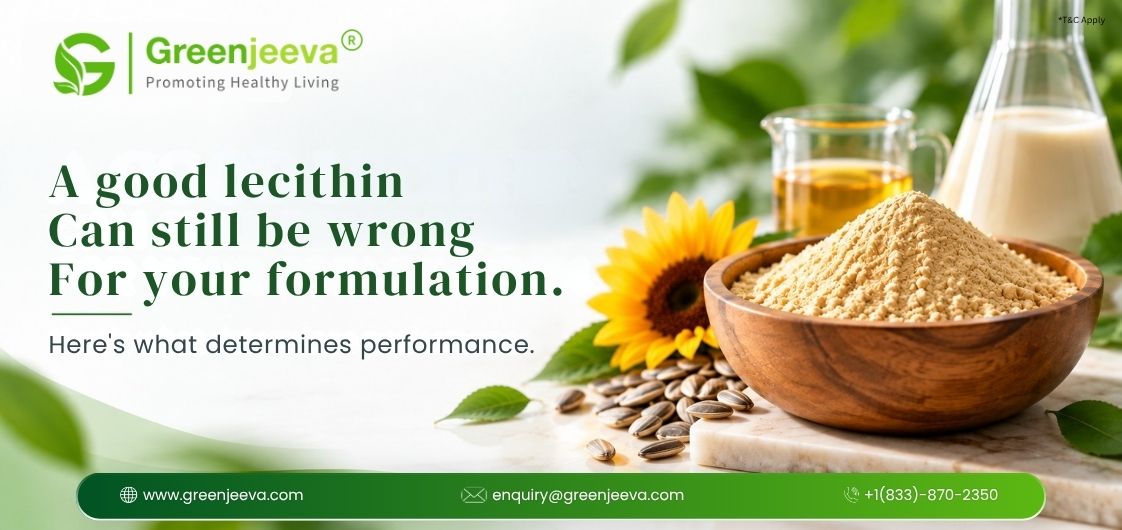
Sunflower lecithin powder is often selected for its emulsifying and dispersing functionality, but the ingredient itself is only one part of the equation. Its performance depends on the formulation it enters, the physical characteristics of the powder, processing conditions, dosage, and how the ingredient interacts with the other components in the system.
For food manufacturers, this distinction matters. A lecithin that performs well in one formulation may require different processing conditions or dosage in another. Research on lecithin-based food systems shows that factors such as oil and water composition, lecithin concentration, viscosity, and processing conditions can influence emulsion behavior and final product properties.
So, when evaluating sunflower lecithin for food manufacturers, the relevant question is not simply whether lecithin is an effective emulsifier. It is whether the ingredient's characteristics and processing requirements align with the specific formulation.
What Does Sunflower Lecithin Actually Do in a Food Formulation?
Lecithin is a complex mixture of phospholipids and other lipid components. Its phospholipids have both water-attracting and oil-attracting regions, allowing them to interact at interfaces between otherwise difficult-to-mix phases. This surface-active behavior is central to lecithin's role in food formulation.
Depending on the formulation, sunflower lecithin powder may contribute to:
- Emulsification of oil and water phases
- Dispersion of lipid-based ingredients
- Wetting of powders
- Improved handling of certain dry ingredients
- Control of texture or rheological behavior in some fat-based systems
- More consistent incorporation of specific ingredients during processing
The exact function depends on the formulation. Lecithin is not simply added at a fixed rate and expected to behave identically across every food system.
For example, studies of lecithin in cocoa-based systems have found that lecithin source and concentration can influence viscosity, crystallization behavior, and rheological properties.
That is why formulation trials remain important even when the ingredient has an established history of use in a particular application.
The Formulation Determines How Lecithin Performs
The same sunflower lecithin powder can behave differently depending on the environment in which it is used.
Oil-to-water ratio
The relative proportions of oil and water can affect how an emulsifier behaves at the interface. In a sunflower oil-water-lecithin model system, changes in water fraction were associated with changes in emulsion behavior and phase characteristics.
A formulation with a high oil load therefore cannot necessarily be approached in the same way as a low-fat or predominantly aqueous system.
Fat composition
The type and structure of fats in a formulation can also influence lecithin functionality. Lecithins have been shown to affect the crystallization and structuring behavior of fat systems, with the effect depending partly on lecithin characteristics and hydrophobicity.
This becomes particularly relevant in products such as chocolate, spreads, fillings, and other fat-continuous systems.
Temperature
Temperature can affect both the physical state of fats and the way ingredients are incorporated. A lecithin addition that works under one processing temperature may not behave identically when the manufacturing process changes.
For this reason, formulation trials should replicate the intended production conditions as closely as possible rather than relying solely on room-temperature laboratory mixing.
Mixing and shear
Mixing intensity, time, and equipment can influence how efficiently lecithin is distributed throughout a formulation.
A laboratory trial using a small high-shear mixer may produce a different result from a production line using a continuous mixer, ribbon blender, or other industrial equipment. The ingredient has not necessarily changed. The processing environment has.
Order of addition
When lecithin is introduced can also matter.
Depending on the product, it may be incorporated into the fat phase, dispersed into a dry blend, or added during another stage of processing. The appropriate approach depends on the formulation and the manufacturer's process.
This is one reason supplier recommendations should complement, rather than replace, application-specific trials.
Powder Characteristics Matter More Than the Ingredient Name
Two ingredients can both be described as sunflower lecithin powder while still having different specifications and physical characteristics.
For a formulator, the name on the ingredient list is only the starting point.
Important characteristics to evaluate may include:
Particle size and physical form
Particle size can affect powder handling, dispersion, and incorporation into dry formulations.
A formulation team should consider whether the ingredient needs to disperse quickly into a dry blend, integrate into a fat phase, or undergo another processing step before reaching its final state.
Moisture
Moisture can influence powder handling, storage stability, and processing behavior. It should therefore be considered alongside the manufacturer's specified storage conditions and shelf life.
Phospholipid composition
Phospholipids are central to lecithin's surface-active functionality. Commercial lecithins are complex mixtures rather than a single purified compound, so composition and specification are relevant when comparing ingredients from different sources.
A recent study characterizing sunflower lecithin powder also found measurable differences in physicochemical properties such as phospholipid content, moisture, peroxide value, and acid value between lecithin samples.
This does not mean that one specification is automatically appropriate for every food product. It reinforces the need to match the ingredient specification with the intended application.
Batch consistency
For commercial production, the question is not only whether one sample performs well.
The same performance needs to be reproducible across production lots.
That makes the relationship between specification, testing, manufacturing controls, and supplier quality systems particularly important when approving an ingredient for ongoing production.
How Processing Conditions Affect Performance
Once the ingredient enters production, the formulation process becomes just as important as the ingredient specification.
Dry blending
For powdered foods, lecithin may need to be incorporated uniformly into a dry matrix. Mixing sequence, particle characteristics, ingredient ratios, and equipment can influence distribution.
Fat-phase incorporation
In fat-based formulations, lecithin may be incorporated into the lipid phase before other ingredients are added. Temperature and mixing conditions then become important considerations.
Pre-dispersion
Some formulations may benefit from dispersing the lecithin before it is introduced into the complete system. Whether this is necessary depends on the product and process.
Processing time
More mixing is not automatically better. Excessive processing can affect temperature, aeration, texture, or other formulation characteristics.
The objective is consistent distribution under the actual production conditions.
Scale-up
A laboratory formulation may use a few hundred grams of material, while commercial production may involve hundreds of kilograms or more.
At that point, mixing geometry, energy input, residence time, heat transfer, and addition rates can change.
A successful bench trial should therefore be treated as a starting point for scale-up validation, not as proof that the same conditions will transfer unchanged to commercial production.

Sunflower Lecithin Applications: Where Does Powder Form Fit?
Sunflower lecithin is used across several food categories because of its surface-active functionality. Its suitability, however, depends on the requirements of the finished product.
Common sunflower lecithin applications include:
Bakery and baked mixes
Lecithin can be incorporated into bakery formulations where emulsification, ingredient distribution, or dough and batter handling are relevant considerations.
Chocolate and confectionery
Lecithin has a long history of use in chocolate and cocoa-based systems. Research has shown that lecithin source and concentration can influence the rheological behavior of spreadable cocoa cream and other fat-based systems.
Powdered beverages and dry mixes
In powdered systems, the ability of the ingredient to disperse and integrate into the blend can be important. The final performance depends on the complete formulation and processing method.
Dairy and plant-based formulations
Lecithin may be considered where oil-water interactions, dispersion, or emulsion stability are relevant to the product design.
Nutrition and sports-nutrition powders
In dry nutritional formulations, physical handling and uniform distribution can be just as important as the ingredient's functional role.
The key point is that an application category does not define a universal dosage or processing method. Formulators still need to evaluate the ingredient within the intended product system.
Organic Sunflower Lecithin Powder: Does Organic Status Change Formulation Performance?
Organic certification and functional performance should be treated as separate evaluation criteria.
An organic sunflower lecithin powder still needs to meet the physical, chemical, microbiological, and functional requirements established for the finished formulation. At the same time, manufacturers producing certified organic foods may have additional requirements concerning ingredient sourcing and certification.
When evaluating an organic ingredient, buyers should verify:
- Applicable organic certification
- Certification scope and current validity
- Ingredient identity
- Processing and handling documentation
- Lot traceability
- Specification and COA
- Allergen and GMO documentation where applicable
- Storage and handling requirements
The organic status of an ingredient should therefore not be treated as a substitute for a technical specification.
For manufacturers developing an organic product, the practical question is whether the organic sunflower lecithin powder meets both the certification requirements and the functional requirements of the formulation.
Sunflower Lecithin vs Soy Lecithin: What Should Formulators Compare?
The comparison between sunflower and soy lecithin should go beyond simply asking which source is “better.”
For formulation development, consider:

For products sold in the United States, FDA food-allergen labeling requirements include declaration of major allergen food sources when applicable. FDA specifically gives “lecithin (soy)” as an example of how the source can be identified on a label.
The choice should therefore be based on the formulation's functional requirements, labeling strategy, sourcing requirements, certification needs, and the specifications of the actual ingredient being evaluated.
What Should Food Manufacturers Ask Their Sunflower Lecithin Supplier?
Once the formulation team has established the functional requirements, supplier qualification becomes the next step.
A prospective sunflower lecithin supplier should be able to provide clear documentation covering the ingredient's identity, specifications, quality controls, and traceability.
Ask for:
1. A complete specification
The specification should clearly identify the product and the parameters relevant to its intended use.
2. A representative COA
A Certificate of Analysis allows the buyer to compare the delivered batch against the agreed specification.
3. Microbiological and contaminant testing
The appropriate testing depends on the ingredient and intended application, but food manufacturers should establish their required limits before approval.
4. Allergen and GMO documentation
These documents can be important for formulation, labeling, and customer requirements.
5. Organic certification
For an organic formulation, verify the certification rather than relying only on an “organic” product description.
6. Processing information
Understanding how the lecithin is produced and processed can help the R&D team assess whether the ingredient is suitable for its intended application.
7. Sample-to-bulk consistency
A development sample is useful only if commercial lots can deliver comparable characteristics.
8. Supply capability
For ongoing production, evaluate MOQ, available inventory, lead times, production capacity, and the supplier's ability to maintain supply as demand increases.
These questions help distinguish a sunflower lecithin powder supplier that can support commercial formulation from a supplier that can provide only a single development sample.
From Lab Trial to Bulk Production: What Changes?
Moving from a laboratory sample to bulk sunflower lecithin powder introduces another layer of evaluation.
At development scale, a formulator may have tight control over:
- Ingredient weighing
- Addition sequence
- Mixing time
- Temperature
- Mixing intensity
- Batch size
Commercial production introduces variables that may not be obvious during initial trials.
A larger batch can change how quickly ingredients disperse. Equipment geometry can alter mixing efficiency. Ingredient addition rates can change. Storage conditions can also affect how a powder handles between receipt and production.
For this reason, commercial approval should consider three stages:
Laboratory evaluation → pilot or scale-up trial → commercial production
At each stage, manufacturers can compare key characteristics and finished-product performance.
This approach is particularly important when moving from sample quantities to bulk purchasing, because a reliable bulk sunflower lecithin powder program requires more than a satisfactory first sample.
A Practical Evaluation Framework for Sunflower Lecithin Powder
Before approving a lecithin for commercial food production, R&D and procurement teams can evaluate the ingredient across nine areas:
1. Functional requirement
What exactly needs to happen in the formulation?
2. Physical characteristics
Does the powder's physical form suit the intended process?
3. Specification
Does the ingredient meet the technical requirements established for the product?
4. Sample performance
Does it perform under realistic formulation conditions?
5. Processing compatibility
Does performance remain consistent under the intended mixing, heating, and addition conditions?
6. Documentation
Are COAs, testing records, certifications, allergen statements, and other required documents available?
7. Batch consistency
Can the supplier demonstrate consistent quality across lots?
8. Supplier capability
Can the supplier support the required MOQ, lead time, documentation, and production volume?
9. Scale-up performance
Does the ingredient continue to perform when the formulation moves from the lab to commercial manufacturing?
The Bottom Line
Sunflower lecithin powder should not be evaluated as a standalone emulsifier with one universal performance profile. Its behavior is shaped by the formulation, ingredient characteristics, processing conditions, dosage, and scale.
For food manufacturers, that means supplier selection and formulation development should work together. A suitable ingredient should meet the required specification, perform under realistic processing conditions, and remain consistent as production moves from development quantities to commercial volumes.
Choosing the right sunflower lecithin supplier therefore involves more than comparing price per kilogram. For manufacturers requiring certified organic ingredients, the same principle applies when evaluating an organic sunflower lecithin supplier: certification, technical documentation, traceability, and formulation performance all need to align.
The strongest sourcing decision is one supported by both formulation data and supplier documentation.