
Move Over Spirulina: Why Alfalfa Grass Powder Is the Ingredient Formulators Are Quietly Betting On
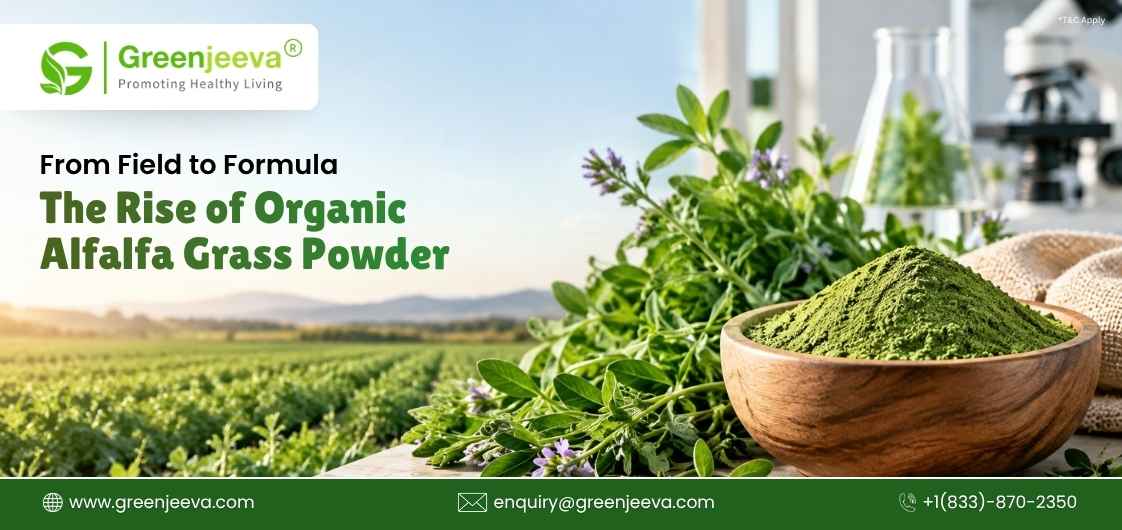
For years, green superfood powders have been dominated by a familiar lineup spirulina, chlorella, wheatgrass, kale. But a quieter contender has been building momentum in the background of North America's clean-label and functional wellness space. And that is organic alfalfa grass powder.
It's not a new plant. Alfalfa has been cultivated for centuries, mostly known as livestock forage. But a shift in how it's grown, harvested, and processed has turned this humble crop into a functional green ingredient that formulators, procurement teams, and emerging wellness brands are starting to take seriously and it's fueling growing demand for a reliable alfalfa ingredient supplier that can support consistent, traceable sourcing.
This article breaks down what's driving the rise of alfalfa grass powder, how it's made, what sets it apart from other green powders, and why bulk alfalfa powder for manufacturers is becoming a go-to raw material for green drinks, capsules, and clean-label formulations.
From Cattle Feed to Clean-Label Ingredient
Alfalfa, scientifically known as Medicago sativa, is a cool-season perennial legume that has long been used as a forage crop for livestock. It's native to central Asia and was introduced to the United States in the 1800s, and it's still one of the most widely cultivated hay crops in the world.
What's changed isn't the plant it's the process. When alfalfa is grown under certified organic farming systems, harvested at optimal maturity, and processed using controlled low-temperature drying methods, it becomes something entirely different from the coarse hay used in animal feed. The result is a fine, green, uniform powder suited for human-grade formulations rather than the feed trough.
That transformation from a bulk agricultural commodity to a traceable, spec-driven ingredient is a big part of why organic alfalfa grass powder is starting to show up in green blends, smoothie mixes, and capsule formulations aimed at wellness-conscious consumers.
The Market Numbers Behind the Trend
Ingredient trends don't happen in a vacuum, and the data behind alfalfa grass powder suggests this isn't a passing niche interest. The organic alfalfa grass powder market is estimated at roughly USD 120 million in 2024, with projections putting it at around USD 250 million by 2033 a compound annual growth rate of about 9.2%.
That kind of growth curve tends to catch the attention of procurement leads and formulators looking for the next ingredient to build around, especially in a market where consumers are increasingly scrutinizing what's in their "green" products.
What Is Organic Alfalfa Grass Powder?
Organic alfalfa grass powder is made from the aerial parts of the alfalfa plant the grass and leaves, not the roots. The process typically involves:
- Harvesting - Leaves are picked at a specific stage of maturity to optimize composition.
- Washing - Removing soil, debris, and surface contaminants.
- Low-temperature drying - Preserving the plant's natural green color and structural integrity while avoiding heat-driven degradation.
- Fine grinding - Producing a consistent particle size suitable for blending into powders, capsules, and beverage formulations.
Some producers also offer alfalfa grass juice powder, where the juice is pressed from fresh alfalfa grass and then dried, rather than drying and grinding the whole leaf. Both approaches are used commercially, and each has its own handling and formulation characteristics something worth understanding if you're comparing an organic alfalfa powder bulk supplier against another or building a spec sheet.
Composition: What's in the Powder
Alfalfa's nutrient and phytochemical profile is one of the reasons formulators are paying closer attention. As a legume, it naturally contains minerals such as potassium, calcium, phosphorus, magnesium, and iron, along with trace amounts of copper, manganese, boron, cobalt, and molybdenum.
Beyond minerals, alfalfa also contains a range of naturally occurring plant compounds, including saponins, phytosterols, coumarins, flavonoids, phytoestrogens, and alkaloids. The powder also carries chlorophyll, which contributes to its characteristic deep green color a visual cue that's become something of a shorthand for "clean, plant-based, minimally processed" in consumer-facing green products.
From a formulation standpoint, alfalfa grass powder is also a source of dietary fiber and plant protein, along with a modest carbohydrate content, which is part of why it fits so easily into green smoothie blends, juice powders, and capsule-based products.
Why Formulators Are Choosing Alfalfa Over Other Greens
So, what's actually pulling attention away from the usual green-powder lineup?
1. Clean-label appeal. Alfalfa fits neatly into the "recognizable ingredient" trend — it's a single plant, minimally processed, with a name most consumers already associate with something natural (even if their only prior reference point was "that thing farm animals eat").
2. Certification and traceability.USDA organic alfalfa powder is available with full certification, and reputable suppliers test samples before accepting organic status claims. For brands building trust with increasingly label-literate consumers, that kind of documentation matters.
3. Versatility across formats. The powder blends into smoothies, juices, capsules, tablets, and bars without requiring major reformulation work. Its neutral-to-mild grassy flavor profile makes it easier to incorporate than some stronger-tasting greens.
4. Dietary compatibility. Because it's plant-derived, alfalfa grass powder fits vegan and vegetarian product lines. It's also commonly produced as gluten-free, dairy-free, and free of major allergens like peanuts, tree nuts, and soy, depending on the facility details that matter a great deal for label compliance and cross-contamination protocols.
5. Regulatory and safety documentation. Because alfalfa is a plant-derived material, it's inherently free of BSE/TSE (bovine spongiform encephalopathy and transmissible spongiform encephalopathy) concerns, which only apply to animal-derived ingredients. That's a straightforward but useful line item for regulatory and quality teams building ingredient dossiers.

Quality Control: What Reputable Suppliers Test For
As with any raw material moving into commercial formulations, quality control is where the real due diligence happens. For alfalfa grass powder bulk orders, that typically includes:
- Organoleptic testing - Confirming color (characteristic green), odor, and physical form meet spec.
- Microbial testing - Ensuring the powder meets recognized standards (such as USP) for microbial counts, particularly important since the powder isn't heat-sterilized in the same way some other ingredients are.
- Moisture content testing - Controlling moisture is critical for shelf stability and preventing microbial growth during storage.
- Processing method verification - Reputable suppliers avoid ETO (ethylene oxide) treatment and irradiation, both of which can alter the chemical makeup, nutritional content, and sensory qualities of a botanical ingredient.
- Shelf-life validation - Alfalfa grass powder is typically rated for a shelf life of around 24 months when stored properly.
Buyers sourcing bulk alfalfa powder for manufacturers should expect documentation Certificates of Analysis, country-of-origin data, and test method transparency as standard practice, not an added extra.
Where the Supply Chain Actually Runs
Alfalfa is grown commercially across a fairly wide geographic footprint, with major producing regions including Canada, Australia, Iran, Argentina, Spain, Russia, the United States, and China. That diversity gives buyers some flexibility in sourcing, though individual batches will typically carry a specific country-of-origin designation depending on the supplier and harvest.
For procurement teams, this geographic spread is worth understanding not just for sourcing strategy, but for traceability documentation, since country of origin, farming certification, and processing location can all affect how a batch is positioned for organic or clean-label claims.
Two Product Forms: Grass Powder vs. Juice Powder
Suppliers working with alfalfa typically offer it in more than one form, and the distinction matters for formulators:
- Organic Alfalfa Grass Powder - Made from whole harvested leaves that are washed, dried, and finely ground. This version retains more of the plant's fiber structure.
- Alfalfa Grass Juice Powder - Made by extracting the juice from fresh alfalfa grass first, then drying that juice into a powder. This process tends to concentrate certain water-soluble compounds while reducing the fiber content relative to the whole-leaf version.
Choosing between the two often comes down to the formulation goal whether a brand wants a fiber-inclusive green powder or a more concentrated, juice-derived extract for a smoother finished product texture.
Choosing the Right Alfalfa Ingredient Supplier
The broader story here isn't really about one ingredient it's about where clean-label green nutrition is heading. Consumers are asking more questions about sourcing, processing, and certification, and ingredients that can answer those questions with real documentation are the ones gaining ground.
When evaluating an organic alfalfa powder bulk supplier, procurement teams typically weigh a few key factors: consistent batch-to-batch quality, USDA organic certification with sample-tested proof, transparent country-of-origin data, and the ability to support both small-batch and bulk alfalfa powder orders as brands scale.
For brands building the next generation of green drinks, capsules, or clean-label blends, it may be worth putting organic alfalfa grass powder on the shortlist not necessarily to replace spirulina or wheatgrass outright, but to diversify a green-ingredient lineup with something that's been quietly building both market traction and formulation credibility.
Conclusion
Alfalfa's journey from forage crop to functional green powder reflects a broader shift happening across the ingredient supply chain one where traceability, certification, and processing transparency are becoming just as important as the raw material itself. Whether sourced as a whole-leaf grass powder or an alfalfa grass juice powder, this ingredient is positioning itself as a serious option for formulators looking to build clean-label products backed by real documentation, a dependable alfalfa ingredient supplier, and a scalable, diversified global supply chain.