
High-Quality Moringa Powder: Bulk Supplier Guide for Quality, Sourcing & Compliance
Sourcing high-quality moringa powder in bulk is no longer a simple ingredient decision. As moringa becomes more widely used across supplements, functional foods, and wellness formulations, procurement teams are increasingly encountering quality inconsistencies that only surface at scale—after formulations are locked, labels are printed, or regulatory reviews begin.
Color alone does not define quality. Origin claims are not guarantees. And not all moringa powders marketed as “premium” meet the operational, documentation, and consistency requirements that bulk buyers depend on.
This guide is written for procurement teams, formulators, R&D leads, and sourcing managers who need to evaluate bulk moringa powder suppliers and manufacturers based on measurable quality benchmarks, compliance readiness, and long-term reliability—not marketing claims.
What Is Considered High-Quality Moringa Powder?
High-quality moringa powder begins at the agricultural and processing level, long before it reaches a warehouse or blending facility.
From a bulk buyer’s perspective, quality is defined by leaf purity, processing discipline, and chemical stability, not by visual appeal alone.
Key characteristics of high-quality moringa powder include:
Leaf-only material
Premium moringa powder should be derived exclusively from Moringa oleifera leaves. Inclusion of stems or fibrous plant matter dilutes nutrient density and affects particle consistency.
Controlled drying conditions
Low-temperature or shade drying helps preserve sensitive phytonutrients and prevents browning, which often indicates oxidation or heat damage.
Uniform particle size
In bulk applications, inconsistent grind size leads to blending issues, sedimentation in beverages, and uneven capsule fill weights.
Fresh aroma and stable color
A dull or musty odor can signal aged material, moisture exposure, or poor storage practices.
For B2B buyers, these indicators must be supported by objective testing and documentation, not subjective descriptions.

Why Bulk Buyers Must Evaluate Moringa Powder Differently
Sourcing bulk moringa powder introduces challenges that are rarely visible in small-scale or retail formats.
At scale, even minor quality deviations can lead to:
- batch rejections during QA testing
- microbial failures after shipment
- inconsistent nutrient claims across lots
- shortened shelf life due to moisture variability
Bulk procurement also amplifies risk exposure. Once moringa powder is integrated into a formulation, replacing a supplier mid-cycle can disrupt production schedules, labeling timelines, and customer commitments.
This is why bulk buyers must evaluate moringa powder suppliers based on repeatability, documentation readiness, and process control, not just initial sample quality.
Key Quality Parameters Buyers Should Verify Before Sourcing
Before approving a high-quality moringa powder bulk supplier, procurement teams should verify the following parameters at a batch level:
Botanical Identity
- Confirm the material is Organic Moringa Leaf Powder (Moringa oleifera).
- Supplier should provide botanical verification or authentication documentation.
Moisture Content
- Excess moisture increases microbial risk and accelerates degradation.
- Bulk moringa powder should meet defined moisture limits suitable for long-term storage.
Microbial Standards
- Total plate count, yeast, mold, and pathogen testing must align with food or supplement application requirements.
- Each batch should be supported by a Certificate of Analysis (COA).
Heavy Metals & Residues
- Lead, arsenic, cadmium, and mercury testing is essential, especially for supplement and functional food applications.
- Pesticide residue testing is critical for organic claims.
Batch-Level Documentation
- COA per lot (not generic)
- Traceability records
- Retained samples for verification
This checklist is where many moringa powder manufacturers differentiate themselves—or fail.

Certifications & Compliance Expectations for Premium Moringa Powder
“Premium moringa powder” in a B2B context is less about branding and more about regulatory readiness.
Depending on end-use, buyers should expect:
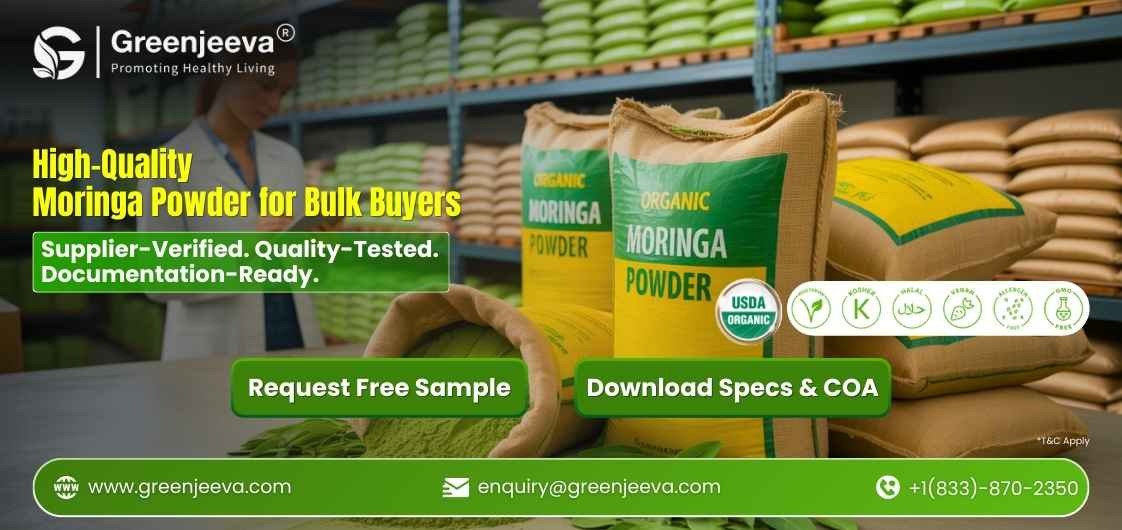
- USDA Organic certification (or equivalent): Essential for clean-label and organic product positioning.
- Non-GMO status: Often required by downstream brands and retailers.
- Allergen statements: Particularly important for shared processing environments.
- FSMA-aligned food safety practices: Suppliers serving the U.S. market must demonstrate food safety controls and documentation readiness.
A premium moringa powder supplier should be able to provide these documents without delay, not after repeated follow-ups.
Choosing the Right Moringa Powder Supplier or Manufacturer
Selecting a reliable moringa powder supplier or manufacturer requires more than comparing price points.
Procurement teams should evaluate suppliers based on:
Supply chain transparency
Clear sourcing regions, harvest practices, and processing controls.
Consistency across batches
- Samples should accurately reflect production material—not one-off showcase lots.
Documentation discipline
- COAs, organic certificates, and compliance records should be readily available and current.
Scalability
- Ability to support repeat bulk orders without quality drift.
Communication reliability
- Clear responses during quality inquiries often reflect how issues will be handled post-contract.
For U.S.buyers in particular, working with ahigh-quality moringa powder bulk supplier in the USA can reduce lead times, simplify compliance workflows, and improve supply chain resilience.
Where High-Quality Moringa Powder Is Used in Formulations
High-quality moringa powder is valued across multiple B2B formulation categories due to its versatility and nutrient profile.
Common applications include:
Dietary supplements
- Capsules, tablets, and powdered blends requiring consistent particle size and stable composition.
Functional foods
- Nutrition bars, meal replacements, and fortified foods where color and taste must remain predictable.
Beverage mixes
- Dry blends and functional drink formulations where dispersion and sediment control are critical.
Wellness & personal care
- Select topical or ingestible applications where botanical integrity matters.
In all cases, formulation success depends on consistent raw material behavior, which reinforces the importance of sourcing from a dependable supplier.
Final Takeaway for B2B Buyers
Sourcing high-quality moringa powder in bulk is a strategic procurement decision—not a commodity purchase.
For buyers focused on long-term formulation stability, regulatory confidence, and brand integrity, success depends on:
- rigorous quality verification
- supplier transparency
- documentation readiness and consistent batch performance
By evaluating moringa powder suppliers against these criteria, procurement teams can reduce risk, improve operational efficiency, and build more resilient ingredient supply chains.