
Organic Chaga Mushroom Powder and the Trends Set to Shape 2027
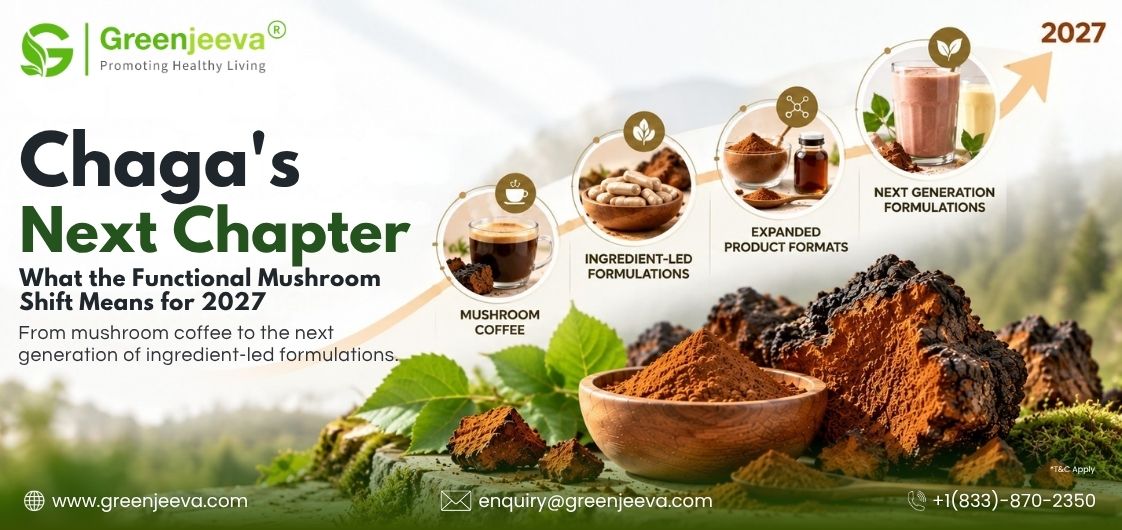
The functional mushroom aisle looks very different from a few years ago. What once appeared mainly in specialist supplements is finding its way into coffee blends, ready-to-drink beverages, nutrition bars, and everyday wellness products. Chaga mushroom, known scientifically as Inonotus obliquus, is part of this expanding ingredient conversation.
For manufacturers, however, the next phase is not simply about adding another mushroom to a product label. It is about understanding where demand is moving, which applications have commercial potential, and how ingredient selection can support consistent, market-ready formulations.
As the industry moves toward 2027, the signals from 2025 and 2026 point to a more competitive category in which product format, ingredient transparency, and formulation decisions may matter as much as consumer awareness.
The Functional Mushroom Market Has Moved Beyond Niche Supplements
The numbers suggest that functional mushrooms have gained meaningful commercial traction in the United States.
According to SPINS data reported by NutraIngredients on September 28, 2026, functional mushroom sales reached $494.7 million across Natural, Conventional Multi-Outlet, and Amazon channels for the 52 weeks ending September 6, 2026. Dollar sales increased 23.2%, while unit sales rose 34.8%.
The same report identified growing interest in convenient formats, including functional beverages, nutrition bars, and gummies. Powder remained the largest format, with reported sales of $110.8 million.
Source: NutraIngredients, September 2026.
This growth provides useful context for manufacturers working with organic chaga mushroom powder. It signals a broader commercial environment in which functional mushroom ingredients are appearing across more product categories.
It does not, however, establish Chaga's individual market share or prove that demand for Chaga powder is growing at the same rate. Buyers and product developers need to distinguish broader category momentum from ingredient-specific demand.
What Changed During 2025 and 2026
Two developments help explain the direction of the category.
Functional mushrooms entered more everyday food and beverage formats.
In July 2025, Axios reported NielsenIQ data showing that U.S. sales of food and beverages containing functional mushrooms had reached $241.4 million through July 12, 2025, compared with $43.6 million over the corresponding period in 2021. That represents an increase of more than 450%.
The report also cited Circana data showing mushroom coffee dollar sales up approximately 55% and volume sales up 74% over the relevant year-over-year comparison period through July 2025. Despite this growth, mushroom coffee represented less than 1% of coffee sales.
These figures reveal two sides of the opportunity. Functional mushrooms have expanded beyond traditional supplement formats, but individual applications such as mushroom coffee still have room to grow rather than representing a fully mature mainstream market.
For Chaga suppliers, this creates a relevant question for 2027: which applications can deliver a distinctive product experience while meeting the technical requirements of commercial manufacturing?
Product differentiation is becoming more important.
As more mushroom products enter the market, simply including a recognizable functional ingredient may not be enough to distinguish one formulation from another.
Innova Market Insights' July 2025 food-trend coverage documented examples of coffee and powdered beverage products combining functional mushrooms with ingredients such as plant proteins and other specialty ingredients.
These combinations point toward a broader product-development approach in which mushrooms are part of a formulation rather than the entire proposition.
For manufacturers considering Chaga mushroom supplements, coffee, or tea blends, the implication is practical. The ingredient must fit the product's intended use, sensory profile, processing conditions, and positioning.
Source: Innova Market Insights, July 2025.
Why Chaga Could Have a Place in the Next Formulation Wave
Chaga offers manufacturers an established ingredient identity within the functional mushroom category. Its naturally dark appearance and earthy, bitter flavor can be relevant when developing mushroom beverages, botanical blends, and other products with compatible sensory profiles.
Yet a promising concept and a commercially suitable ingredient are not the same thing.
A product developer evaluating organic Chaga mushroom powder should first establish whether the ingredient is appropriate for the intended application.
For example, a tea blend may accommodate the characteristic flavor of Chaga, while a coffee formulation may require careful balancing with the roast profile and other ingredients. A capsule formulation may place greater emphasis on powder characteristics, fill weight, and manufacturing compatibility.
The distinction between powder and extract also matters. Plain Chaga mushroom powder consists of processed fungal material, whereas an extract has undergone an extraction process intended to concentrate or selectively recover particular constituents. Their composition and formulation behavior may differ, so they should not be treated as interchangeable.
For manufacturers, the relevant question is not simply whether Chaga fits the trend. It is whether the selected ingredient supports the product's specifications and intended market.
Three Shifts Worth Watching in 2027
The following are forward-looking industry assessments based on observed category developments, not guaranteed predictions about Chaga-specific sales.
- Everyday formats could create more opportunities
The expansion of functional mushrooms into coffee, beverages, bars, and other familiar formats suggests that convenient applications will remain worth monitoring.
Chaga tea powder and Chaga mushroom coffee are potential areas of interest for developers seeking to incorporate mushrooms into recognizable consumption occasions. However, category growth alone does not guarantee demand for every Chaga-based product.
Manufacturers should assess consumer positioning, flavor compatibility, ingredient cost, and the practical requirements of their chosen format before committing to large-scale production.
- Ingredient transparency could become a stronger differentiator
As the functional mushroom category expands, buyers have good reason to examine what is present in an ingredient rather than relying on a mushroom name or marketing description.
For organic Chaga powder, this begins with confirming the declared material, its processing history, and the supplier's specifications. Where relevant, manufacturers should also clarify whether they are purchasing whole-material powder or an extract, and what analytical data supports the ingredient's identity and composition.
SPINS' September 2026 industry report also identified growing attention to ingredient sourcing, extraction methods, standardization, and distinctions between fruiting bodies and mycelium across the functional mushroom category.
These discussions do not establish a universal specification for Chaga. They do reinforce the importance of matching the ingredient description and available evidence to the product being developed.
- Procurement and formulation may become more closely connected
A formulation decision can affect purchasing requirements long before the first production run.
Particle size, moisture, microbiological quality, contaminant limits, sensory characteristics, and packaging requirements may all influence whether a particular lot is suitable for a manufacturer's process. Extracts may require additional information about extraction conditions, concentration, and standardization.
For a wholesale organic Chaga powder buyer, these details can help establish purchasing specifications and acceptance criteria before commercial quantities are ordered.
The practical opportunity for 2027 is to align R&D and procurement earlier, reducing the risk of selecting an ingredient based on its market appeal without confirming its suitability for production.

What Manufacturers Should Verify Before Sourcing Organic Chaga Powder
Market momentum does not remove the need for ingredient-level due diligence. Manufacturers evaluating a bulk Chaga powder supplier in the USA should consider several areas.
Raw-material identity: Confirm the scientific identity, the declared fungal material, and whether the ingredient is plain powder or extract. Do not assume all products marketed as Chaga powder use identical starting materials or processing methods.
Organic documentation: Where an organic claim is intended, verify the applicable certification, product coverage, and documentation required for the destination market. The USDA Organic framework is relevant to eligible products marketed as organic in the United States, but the claim must be supported by the appropriate certification and supply-chain arrangements.
Certificate of analysis: Review the lot-specific COA where available. Confirm that reported results correspond to the product specification and include appropriate acceptance limits and analytical methods.
Quality testing: Determine which microbiological tests, heavy-metal analyses, pesticide-residue tests, and other checks are appropriate for the ingredient, intended use, risk assessment, and applicable requirements. Not every testing panel is universally required for every product.
Commercial consistency: Discuss packaging, storage conditions, available quantities, lead times, traceability, and the process for addressing out-of-specification lots.
An organic Chaga mushroom powder with COA is not automatically suitable for every formulation. The value of the documentation lies in whether it answers the buyer's specific quality and compliance questions.
For manufacturers, these checks should support the formulation decision rather than serve as a substitute for it.
Looking Ahead to 2027
The functional mushroom category has demonstrated commercial momentum, particularly in the United States, and product innovation has extended its reach beyond traditional supplement formats.
For Chaga, the next opportunity may lie in how manufacturers translate that broader interest into carefully developed products. Coffee blends, teas, supplement formulations, and other applications each have different technical and commercial requirements.
The most useful approach is to treat market growth as a signal to investigate, not a guarantee of success. Manufacturers that connect consumer-facing product concepts with appropriate ingredient specifications, credible documentation, and realistic sourcing plans will be better positioned to evaluate opportunities as the category evolves.
For ingredient suppliers and buyers alike, 2027 is a reason to look beyond the mushroom trend and focus on what makes a formulation commercially workable.