
Can Cauliflower Powder Replace Wheat Flour in Gluten-Free Formulations?
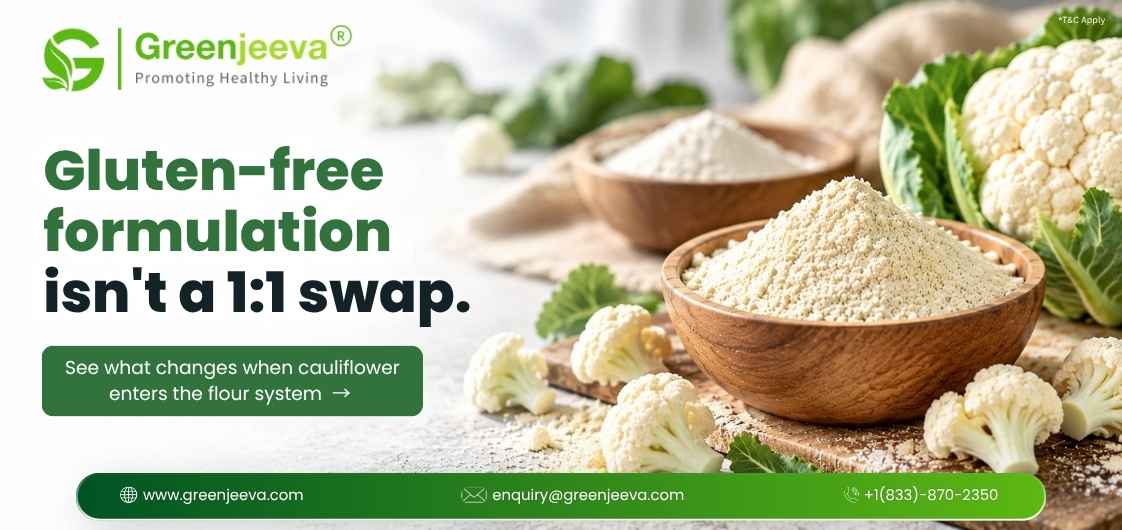
Cauliflower powder is often described as a gluten-free flour alternative. But that phrase can make the formulation question sound simpler than it is.
Replacing wheat flour is not simply a matter of swapping one powder for another. Wheat flour contributes structure, water management, texture, and baking performance. Cauliflower powder brings a different set of physical and compositional characteristics to the formula.
So, can it replace wheat flour?
In some formulations, cauliflower powder can replace part of the wheat flour system. But it should not be treated as a one-to-one functional equivalent of wheat flour.
For food manufacturers, the more useful question is what role cauliflower powder can realistically play in the formula, and what needs to change when it is introduced.
What Makes Cauliflower Powder Different From Wheat Flour?
Cauliflower powder is made by drying and milling cauliflower into a powdered ingredient. Depending on how it is produced, the finished powder can vary in moisture, particle size, color, flavor, and other physical characteristics.
Wheat flour, meanwhile, is a cereal-based flour with starch and gluten-forming proteins that play an important structural role in many baked products.
That distinction matters.
When wheat flour is replaced with an organic cauliflower powder, the formula is not simply receiving a different source of dry solids. It is receiving an ingredient with a different composition and different functional behavior.
This is why cauliflower powder is better considered a vegetable-derived formulation ingredient than a direct replica of wheat flour.
For manufacturers developing gluten-free products, that distinction can help set more realistic expectations from the start.
What Does Cauliflower Powder Contribute to a Formula?
The role of cauliflower powder depends on the product, inclusion level, particle size, and the rest of the formulation.
In a baked or dry-mix application, it can contribute:
- Vegetable solids
- Characteristic cauliflower color and flavor
- Bulk to the dry ingredient system
- Fiber and other naturally occurring constituents
- Changes in moisture and water interaction
- A vegetable component for savory or plant-forward formulations
Its behavior is therefore application specific.
For example, a powder incorporated into a cracker may need to behave differently from one used in a pancake mix or savory baked product. The same cauliflower powder for food manufacturing should not automatically be expected to perform identically across every application.
This is also why particle size and moisture are not just procurement specifications. They can become formulation variables.
Why a 1:1 Wheat Flour Swap Usually Doesn't Work
The biggest misconception around cauliflower powder as a flour alternative is the idea of a simple 1:1 replacement.
Wheat flour provides structural functionality that cauliflower powder cannot reproduce by itself. In conventional wheat-based baking, gluten proteins form a network that helps dough retain gas and develop its characteristic structure.
Cauliflower powder does not create that gluten network.
So, when a manufacturer removes a portion of wheat flour and replaces it with cauliflower powder, several things can change at once:
- Structure: The dough or batter may respond differently because the gluten-forming fraction has been reduced.
- Water balance: Cauliflower powder has its own moisture and water-binding characteristics, so the original hydration level may no longer be appropriate.
- Texture: Changes in particle composition and flour functionality can affect crispness, softness, density, or other textural characteristics.
- Color: Cauliflower powder can alter the appearance of the finished product as its inclusion level increases.
- Flavor: More cauliflower powder can introduce a stronger vegetable character.
- Volume and spread: Changes to the flour system can affect how a product expands, sets, or holds its shape during baking.
In other words, the substitution percentage becomes part of the formulation design rather than a simple ingredient replacement.

What Does Research Say About Cauliflower Powder in Baked Products?
Published research supports the idea that substitution level matters.
A 2024 study examined cauliflower powder as a replacement for wheat flour in tuile cookies at 0%, 10%, 20%, and 30% substitution. As cauliflower powder increased, researchers observed changes in color, hardness, moisture, water activity, and sensory characteristics. Under the specific conditions of that study, substitution up to 20% was considered feasible without a significant difference in overall preference compared with the control.
That does not mean 20% is a universal recommendation for every bakery product. It means that a particular cauliflower powder, processing method, product formula, and baking system produced a workable result at that level.
A separate study using cauliflower by-product powder in muffins found that increasing replacement levels affected baking and physical characteristics, with adverse effects becoming significant above 10% in that specific formulation.
The takeaway is more useful than any single percentage:
There is no universal cauliflower-powder-to-wheat-flour replacement ratio. The appropriate inclusion level depends on the product and the functional requirements of the formula.
That is particularly important when moving from laboratory trials to commercial production.
Where Can Cauliflower Powder Work in Gluten-Free Formulations?
Cauliflower powder can be considered for formulations where the objective is not to recreate wheat flour exactly, but to build a gluten-free product around a different ingredient system.
Potential applications include:
- Cookies and biscuits
- Savory crackers
- Pancakes and dry mixes
- Pizza-style bases
- Savory baked products
- Vegetable-forward snacks
- Selected gluten-free bakery formulations
Research has also examined cauliflower-derived powders in pizza and other bakery systems, showing that cauliflower ingredients can be incorporated into wheat-based formulations while changing technological and sensory properties.
For a completely gluten-free product, however, cauliflower powder would generally need to be part of a broader flour and starch system designed to provide the structure that wheat flour would otherwise contribute.
That could mean combining vegetable powder with other gluten-free ingredients rather than asking cauliflower powder to perform every function of wheat flour on its own.
Cauliflower Powder for Plant-Based Foods Is a Different Formulation Question
The opportunity for cauliflower powder for plant-based foods extends beyond trying to imitate conventional flour.
Here, the ingredient can be used to build a more vegetable-forward formulation while contributing dry solids, color, flavor, and other characteristics to the finished product.
Depending on the product architecture, manufacturers may evaluate it in:
- Plant-based baked goods
- Savory snack formulations
- Vegetable crackers
- Dry mixes
- Savory coatings
- Plant-forward convenience foods
This distinction is useful because gluten-free and plant-based are not the same formulation requirement.
A product can be gluten-free without being plant-based, and a plant-based product does not automatically need to use cauliflower powder. The ingredient needs to earn its place based on the formulation's actual requirements.
What Changes When You Add Cauliflower Powder?
Before replacing wheat flour, formulators should test the variables that are most likely to change the finished product.
1. Inclusion level
Start with controlled substitution trials rather than assuming a fixed replacement ratio.
Small changes in inclusion can affect texture, color, moisture, and sensory properties. Published research demonstrates this relationship in cauliflower-based bakery formulations.
2. Water addition
Removing wheat flour and introducing a vegetable powder changes the dry ingredient system.
Water should therefore be optimized experimentally rather than transferred directly from the original formula.
3. Particle size
A coarse and fine powder can behave differently during blending, hydration, and processing.
For this reason, particle size should be evaluated against the intended application rather than treated as an isolated specification.
4. Texture system
If wheat flour previously supplied much of the product's structure, the formula may need additional gluten-free structural ingredients.
Depending on the product, this could involve starches, hydrocolloids, proteins, or other functional ingredients.
5. Flavor and color
Cauliflower powder is not sensory-neutral. Increasing its inclusion can affect the finished product's color and flavor. The 2024 cookie study observed measurable changes in both as substitution increased.
6. Processing conditions
Mixing, hydration, resting, baking temperature, and baking time may all need adjustment after changing the flour system.
A successful bench formulation should therefore be validated under the actual production process before commercial scale-up.
What Should Manufacturers Specify When Buying Cauliflower Powder?
Once the formulation is established, the next question is consistency.
An organic cauliflower powder supplier should be able to provide enough information for the manufacturer to understand what is being purchased and reproduce the formulation from batch to batch.
Key specifications can include:
- Botanical identity
- Plant part
- Organic certification status
- Processing method
- Moisture
- Particle size or mesh
- Appearance and color
- Microbiological specifications
- Relevant contaminant testing
- Packaging information
- Storage conditions
- Batch-specific COA
- Traceability documentation
For an organic cauliflower powder manufacturer, these specifications also provide a framework for maintaining consistency across production lots.
The exact specifications will depend on the intended application. A powder intended for a dry seasoning blend may not require the same particle-size profile as one being developed for a bakery system.
What Changes When You Buy Cauliflower Powder in Bulk?
At laboratory scale, a formulation may work with a small sample. At commercial scale, consistency becomes much more important.
When purchasing bulk organic cauliflower powder, manufacturers should consider whether the supplier can maintain the same relevant specifications across commercial batches.
This includes asking about:
- Available batch sizes
- Particle-size consistency
- Moisture specifications
- Organic certification
- Testing and COA documentation
- Packaging formats
- Storage requirements
- Sample-to-bulk consistency
- Lead times and supply continuity
The same principle applies when evaluating bulk cauliflower powder or an organic cauliflower powder wholesale program: the purchase decision should be based on the specification required by the formulation, not simply the lowest price per kilogram.
For manufacturers sourcing several ingredients, a bulk vegetable powder supplier may also be able to consolidate sourcing across multiple vegetable ingredients. Even then, each powder should be evaluated against its own identity and application-specific specifications.
What Should You Ask a Cauliflower Powder Supplier Before Scaling?
Before moving from trials to commercial production, ask:
- What botanical identity and plant part are used?
- Is the material certified organic?
- What processing method is used?
- What moisture specification is maintained?
- What particle-size range is available?
- What microbiological testing is performed?
- What documentation accompanies each batch?
- Can a representative sample be provided for formulation trials?
- Can the same specification be maintained at bulk scale?
- What packaging and storage conditions are recommended?
These questions are relevant whether you are comparing an organic cauliflower powder supplier, a conventional cauliflower powder supplier, or an organic cauliflower powder manufacturer.
The important point is to connect the supplier's specification to the formula you are developing.
So, Can Cauliflower Powder Really Replace Wheat Flour?
Yes, but not as a simple one-for-one substitute.
Research shows that cauliflower powder can replace a portion of wheat flour in certain bakery formulations, but the workable level varies with the product, processing conditions, powder characteristics, and the rest of the formula.
For gluten-free manufacturing, the more practical approach is to treat cauliflower powder as one component of a flour system, rather than expecting it to reproduce every function of wheat flour.
That shift in thinking makes formulation trials more productive.
Instead of asking:
“How much wheat flour can we remove?”
ask:
“What role should cauliflower powder play in this formula, and what does the rest of the system need to provide?”
For manufacturers evaluating organic cauliflower powder, that is the more useful starting point. The right ingredient is not simply the one that can be substituted into a formula. It is the one whose specifications and functionality can be matched to the finished product.