
Bulk Organic Cassia Cinnamon Powder Supplier: Specs, COA & MOQ Guide
If you formulate capsules, gummies, functional blends, or clean-label food products, sourcing cinnamon is rarely as simple as "buy the cheapest powder available." Cassia cinnamon's coumarin content, mesh consistency, and microbial load all directly affect your finished product's compliance, shelf life, and performance in encapsulation or blending equipment.
This guide is written for formulators, R&D teams, and private label buyers evaluating a bulk organic cassia cinnamon powder supplier, covering the sourcing standards, technical specifications, and formulation considerations that matter at scale.
Why Cassia Cinnamon Sourcing Standards Matter for Formulators
Cassia cinnamon (Cinnamomum cassia), sometimes called Chinese or Indonesian cinnamon, is the variety most commonly used in bulk supplement and food manufacturing due to its stronger flavor profile and lower cost relative to Ceylon cinnamon. It also naturally contains higher levels of coumarin than Ceylon cinnamon, a compound subject to regulatory limits in several markets. This is why coumarin testing and documentation are part of standard due diligence when sourcing cassia at scale.
Choosing the right supplier affects far more than cost. Documentation, batch consistency, and quality controls all influence production efficiency and regulatory compliance. A supplier who can't document coumarin levels batch-to-batch is putting your product's label claims, and your customers' trust, at risk.
What to Look for in a Supplier
- Certified organic supply chain - from farm to processing, with valid USDA NOP (or equivalent) certification carried through every intermediary, not just at origin.
- Batch-specific documentation - a Certificate of Analysis (COA) tied to the actual lot you're purchasing, not a generic spec sheet reused across shipments.
- Traceability to origin - ability to confirm growing region, harvest window, and processing facility.
- Consistent particle size control - critical for anyone running capsule-filling or tableting equipment, where flow characteristics change with mesh variance.
At Greenjeeva, sourcing runs through vetted organic farms with documented harvest and processing records, and every lot ships with a corresponding COA, because formulators shouldn't have to take purity on faith.

Technical Specifications: Mesh Size, Purity, and COA Availability
Before approving a production run, request measurable specifications rather than relying on marketing claims. Here's what to request from any bulk organic cassia cinnamon powder supplier before you commit to a production run.
Mesh Size Options
Mesh size determines flow rate, bulk density, and how the powder behaves in your specific equipment:
- 40–60 mesh - coarser grind, better suited to teas, seasoning blends, or applications where flowability matters more than fine dispersion.
- 80 mesh - a common mid-range standard for capsule filling on encapsulation machines, balancing flow and fill-weight consistency.
- 100–120 mesh - finer grind for tablet compression, extract processing, or blends requiring smoother mouthfeel and uniform dispersion in liquid or powder matrices.
If your target application isn't listed above, a supplier should be able to run a custom mesh spec - cassia is a commodity that tolerates re-milling without major quality loss, so this is a reasonable ask.
Purity and Coumarin Levels
Request the following on every COA:
- Coumarin content (mg/kg) - relevant for markets with regulatory intake limits; batch variance in cassia can be significant, so this should be tested per lot, not assumed from origin averages.
- Heavy metals panel - lead, arsenic, cadmium, mercury, consistent with USP <232>/<233> or equivalent limits.
- Microbial testing - total plate count, yeast/mold, and pathogen screening (Salmonella, E. coli) relevant to your finished product category.
- Pesticide residue screening - confirming organic status isn't just a certification on paper.
COA Availability
Every lot should ship with a matching COA available before purchase, not after. If a supplier can't provide a COA for the specific lot you're buying - only a "typical values" sheet - treat that as a sourcing red flag, particularly for supplement manufacturers subject to FDA identity and purity testing requirements under 21 CFR 111.

Formulation Use Cases: Capsules, Blends, and Extracts
Capsule and Tablet Manufacturing
Cassia cinnamon powder is a common single-ingredient or supporting component in capsule and tablet formulations. For capsule filling, an 80-mesh grind typically offers the best balance of flow rate and fill consistency on automated encapsulation lines. Bulk density consistency between lots matters here. Inconsistent density forces line operators to recalibrate fill weights, which slows production and increases waste.
Functional Food and Beverage Blends
In spice blends, functional beverage powders, and bakery applications, cassia's flavor intensity means small percentage inclusions carry noticeable sensory impact, making lot-to-lot flavor consistency as important as chemical purity. Coarser 40–60 mesh grinds are generally preferred here for better blend homogeneity with other dry ingredients.
Extracts and Standardized Ingredients
Manufacturers producing cinnamon extracts or standardized cinnamon bark extracts typically require finer mesh (100+) raw material to improve extraction efficiency and yield consistency during solvent or water-based processing. Working from a supplier who can document coumarin and cinnamaldehyde levels pre-extraction simplifies downstream standardization testing.
Facility Compliance: FDA and cGMP Standards
For U.S.-market manufacturers, ingredient sourcing is only as strong as the compliance infrastructure behind it. Green Jeeva sources and processes bulk organic spice powders through facilities operating under current Good Manufacturing Practice (cGMP) standards, aligned with FDA requirements for identity, purity, strength, and composition testing under 21 CFR Part 111 (dietary supplements) and Part 117 (food safety). This means:
- Documented supplier qualification and lot traceability
- Batch testing records available for audit and regulatory review
- Facility practices designed to prevent adulteration and cross-contact
If your finished product is subject to FDA inspection or third-party audit, working with a supplier that can produce this documentation on request is not optional; it's part of your own regulatory file.
Request Your Spec Sheet and COA
If you're evaluating suppliers for an upcoming production run, don't start with pricing, start with documentation. Request the current specification sheet and a sample COA before you commit to volume.
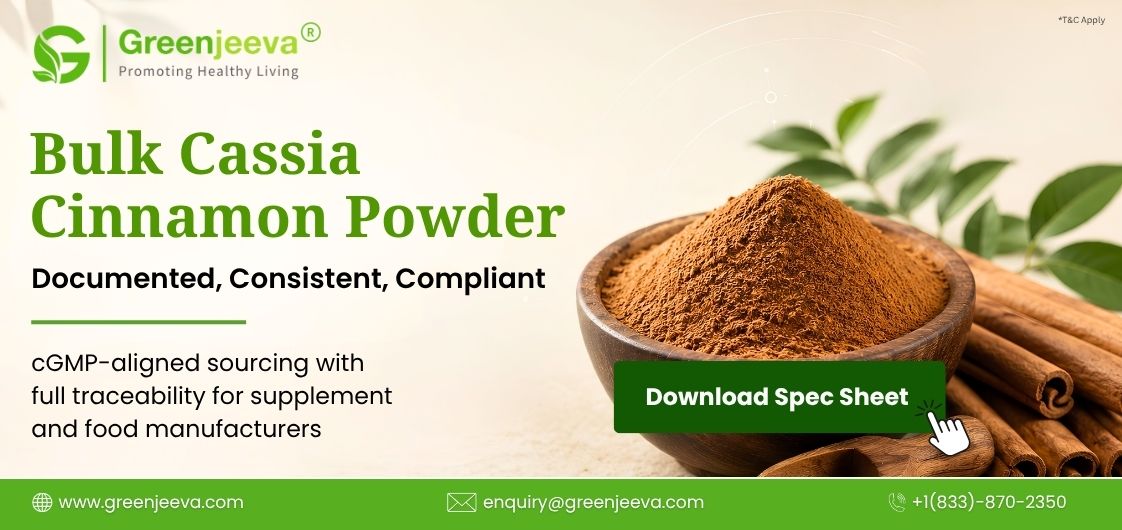
Download the full spec sheet for mesh size options, purity ranges, and typical coumarin values, or contact our sales team to discuss MOQ, custom mesh grinding, and lead times for your next batch.
**The Food and Drug Administration has not evaluated these statements. This product is not intended to diagnose, treat, cure, or prevent any disease.**