
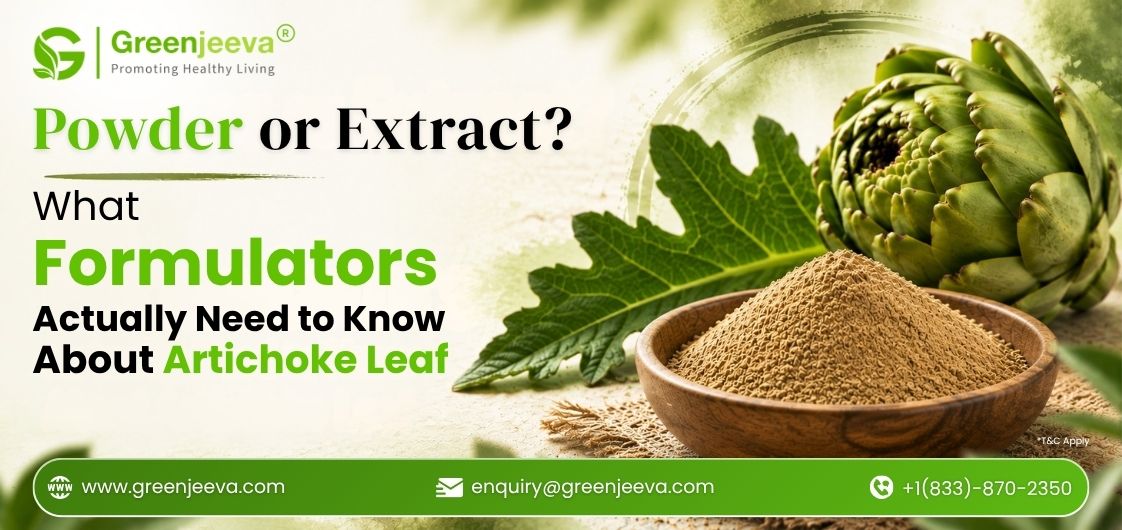
Artichoke Leaf Powder vs. Extract: Understanding the Differences
A formulator emailing a bulk ingredient supplier usually asks one of two things: "What's the difference between your powder and your extract?" or "Which one should I use?" Both questions come up constantly, and most answers online stop at a dictionary-style definition. This guide goes further. It covers what actually changes between powder and extract, where formulators get the comparison wrong, and how to decide which form fits a specific product.
Both ingredients start from the same plant, Cynara scolymus, the globe artichoke. What happens after harvest is where they diverge, and that divergence affects everything from label dosage to shelf stability to cost per finished unit.
What Is Artichoke Leaf Powder?
Artichoke leaf powder is the whole leaf, dried and ground. Nothing is pulled out, nothing is concentrated. Because the full leaf structure is preserved, the powder retains fiber, inulin, and the plant's natural phenolic compounds in roughly the same ratio they exist in the raw leaf.
In practice, this shows up as:
• A mesh size specification (commonly 80 mesh) that determines how the powder blends into finished products
• Moisture content typically held under 10%, since higher moisture increases the risk of microbial growth during storage
• Batch-to-batch variation tied to the growing season, harvest timing, and drying method, since nothing has been standardized out
This variability is not a flaw. It is the nature of a whole-food ingredient, and buyers who want a clean-label or minimally processed positioning often prefer it for exactly this reason.
What Is Artichoke Leaf Extract?
Artichoke leaf extract starts with the same leaf but goes through an additional step: extraction. Manufacturers use water or a water-alcohol solvent to pull soluble compounds out of the plant material, then concentrate and dry that extract into a powder. Because raw material is reduced down, extracts are labeled with a ratio, such as 4:1 or 10:1.
What Does Artichoke Leaf Extract 10:1 Meaning Actually Tell You?
A 10:1 ratio means 10 kilograms of raw leaf produced 1 kilogram of finished extract. It is a processing ratio, not a potency guarantee. This is the single most common misunderstanding in ingredient sourcing: buyers assume a 10:1 extract is automatically stronger than a 4:1 extract, when the extraction efficiency, solvent choice, and drying method all affect how much of the leaf's actual compound content survives the process.
The number that actually indicates strength is the standardization percentage, most often expressed as percent cynarin or percent total caffeoylquinic acids. Two extracts can carry the same ratio and have meaningfully different standardized compound content. If a specification sheet only lists a ratio with no standardization percentage, that is a gap worth asking the supplier to close before committing to a formulation.

Artichoke Leaf Extract vs. Powder: Potency and Dosage
Because extract is concentrated, a smaller amount can reflect a compound load comparable to a much larger amount of raw powder. This is why extract-based supplement labels list smaller milligram amounts than powder-based ones. But potency comparisons based only on extraction ratio miss the point. A 4:1 extract standardized to 5% cynarin can be more consistent, and in practical formulation terms more useful, than a higher-ratio extract with no standardization at all.
For formulators building a label around a specific dose claim, the standardized compound percentage should drive the calculation, not the extraction ratio by itself. This is also why whole leaf powder and extract are not interchangeable on a 1:1 basis. Swapping one for the other without recalculating the target compound level will change what the finished product actually delivers.
Artichoke Leaf Extract vs. Powder Bioavailability
Extraction concentrates target compounds but does not automatically make them more bioavailable. Bioavailability depends more on the delivery format (capsule, tablet, or liquid) and the specific compound in question than on whether the source material was powder or extract. In practice, formulators treat extraction ratio and standardization as the levers for dose and consistency, and treat delivery format as the lever for absorption, rather than assuming concentration alone solves for both.
Common Mistakes Formulators Make When Choosing Between Powder and Extract
• Assuming a higher ratio always means a better ingredient. Ratio without standardization data is an incomplete picture.
• Using powder and extract interchangeably in a reformulation. The compound density is different, so a straight gram-for-gram swap changes the finished product's profile.
• Skipping the Certificate of Analysis. A CoA is the only way to verify standardization percentage, moisture content, and identity testing rather than relying on the label alone.
• Choosing extract purely for a lower per-serving weight. Smaller serving size matters for capsule count and manufacturing cost, but it should not be the only deciding factor if whole-ingredient positioning is part of the brand story.
• Not confirming solvent method. Water-extracted and water-alcohol-extracted products can differ in compound profile and are not always disclosed unless specifically requested.
Which Form Is Better for Supplements: Artichoke Leaf Powder or Extract?
• Choose whole leaf powder for teas, food applications, or products positioned around whole-plant, minimally processed sourcing.
• Choose standardized extract when the formulation requires a consistent, batch-to-batch compound level, a smaller per-serving dose, or documentation to support a specific standardization claim on the label.
Many finished-product brands default to extract for capsules and tablets because standardization simplifies quality control at scale. Powder remains the more common choice for teas, functional foods, and formulations built around a whole-ingredient narrative. This same standardization-versus-whole-ingredient tradeoff shows up across other botanicals we supply; our breakdown of organic vs. conventional ashwagandha root powder covers a related quality question from a different angle, and our look at Jerusalem artichoke powder supply chains covers a different part of the artichoke family entirely, worth knowing since the two are sometimes confused by buyers.

B2B Market Snapshot: Demand for Artichoke Extract and Powder
A few figures worth knowing if you're building a sourcing or formulation strategy around this ingredient:
• The global artichoke extract market was valued at roughly $3.0 billion in 2025 and is projected to grow at a compound annual rate of around 5% through 2030, according to Research and Markets.
• North America leads global demand for artichoke extract, followed by Europe and Asia Pacific, per Verified Market Research.
• Powder formats are expected to be among the fastest-growing segments within the category, largely due to ease of handling and their wide range of formulation uses.
• In the B2B channel specifically, direct sales to manufacturers remain a significant path to market, particularly for nutraceutical, functional food, and cosmetic manufacturers buying in bulk, according to Deep Market Insights.
• Dietary supplements remain the largest end-use segment overall, with functional foods and beverages the fastest-growing category behind it.
For formulators, the takeaway is straightforward: demand for standardized, well-documented artichoke ingredients (both powder and extract) is growing steadily rather than spiking, which supports long-term supplier relationships over one-off spot buys.
Formulator's Pre-Sourcing Checklist
Before finalizing either ingredient, confirm the supplier can provide:
• Certificate of Analysis (CoA) showing standardization percentage, moisture content, and identity testing
• Certified organic documentation (USDA Organic and/or EU Organic, depending on target market)
• Facility certifications relevant to the finished product category (HACCP, GMP, Kosher, Halal)
• Mesh size specification (for powder) or extraction ratio and standardization percentage (for extract)
• Solvent method disclosure (for extract)
• Consistent lot-to-lot testing data, not a single historical CoA