
| Quantity | Price | Save |
|---|---|---|
| XXXXX | XXXXX | -- |
| XXXXX | XXXXX | 10.00% |
| XXXXX | XXXXX | 15.00% |
Want high volume of this product? Please place your Bid.
You can view and download product documents, access detailed product information, place orders, request samples, chat with our experts, and much more.
Botanical Name: Prunus cerasus
Plant Part Used: Fruit
Processing Method: Drying and milling
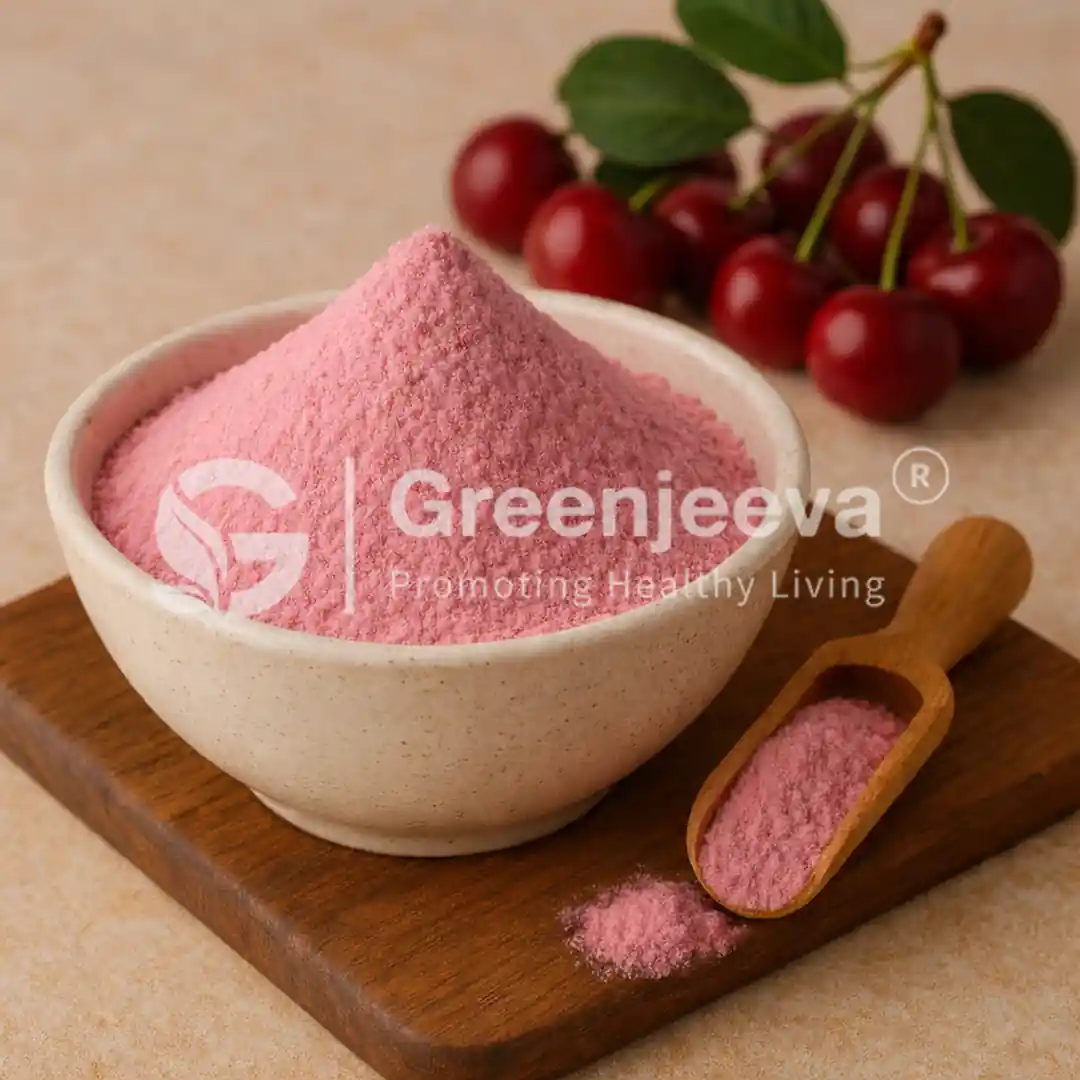
Green Jeeva’s Organic Tart Cherry Powder is produced from carefully harvested fruits of Prunus cerasus, commonly known as tart or sour cherry. The cherries are collected during peak harvest season, gently dried, and finely milled to maintain their natural color profile and fruit matrix integrity. The controlled processing helps retain the characteristic deep red hue and inherent fruit composition suitable for industrial applications.
As a trusted wholesale organic tart cherry powder supplier, we support global manufacturers requiring specification-based sourcing, traceability, and consistent supply continuity. Our product is cultivated under certified organic standards and processed in controlled environments to ensure batch-to-batch uniformity aligned with industrial quality expectations.
| Product Category: | Organics |
| Product Sub Category: | Herbs-Spices-Seasonings |
| Product Mix Category: | Organic RM powders |
| Main Producing Countries | Canada, Turkey, Iran, Poland, Russia, Iceland and United States |
Botanical name for Tart cherry powder is Prunus cerasus.
Organic Tart cherry powder is purple color powder with characteristic odor.
The mesh size we provide is generally between 40-80 mesh.
Percentage for loss on drying is NMT 10%.
It is the residue remaining after the incineration of the drug or plant part. Ash value represents the amount of inorganic salts naturally occurring in the ingredient and adhering to it. It also includes inorganic matter which helps to identify adulteration. Ash value greater than 5% is an indicator of the addition of inorganic metal salts in the product.


Organic Tart Cherry Powder serves diverse manufacturing applications

Capsules, tablets, sachets, functional blends
Drink mixes, smoothie blends, flavored powders
Pre- and post-workout formulations
Fillings, coatings, dessert blends
Fruit-based formulation matrices


Organic Tart Cherry Powder naturally contains
Anthocyanins — natural pigments contributing to its deep red coloration
Polyphenolic compounds characteristic of tart cherry fruit
Naturally occurring organic acids
Fruit-derived phytonutrients supporting botanical authenticity

For applications requiring higher concentration formats, manufacturers may evaluate tart cherry extract powder separately; however, whole fruit powder maintains the complete fruit matrix.

When incorporated into finished systems, Organic Tart Cherry Powder offers
It is commonly utilized in clean-label formulations where fruit-based ingredients and traceable sourcing are procurement priorities.


Sourcing from a qualified organic tart cherry powder bulk supplier ensures technical documentation support for procurement validation, quality audits, and compliance verification.
