
When Does a Formulation Call for Rhodiola Rosea Powder, and When Does It Actually Need an Extract?
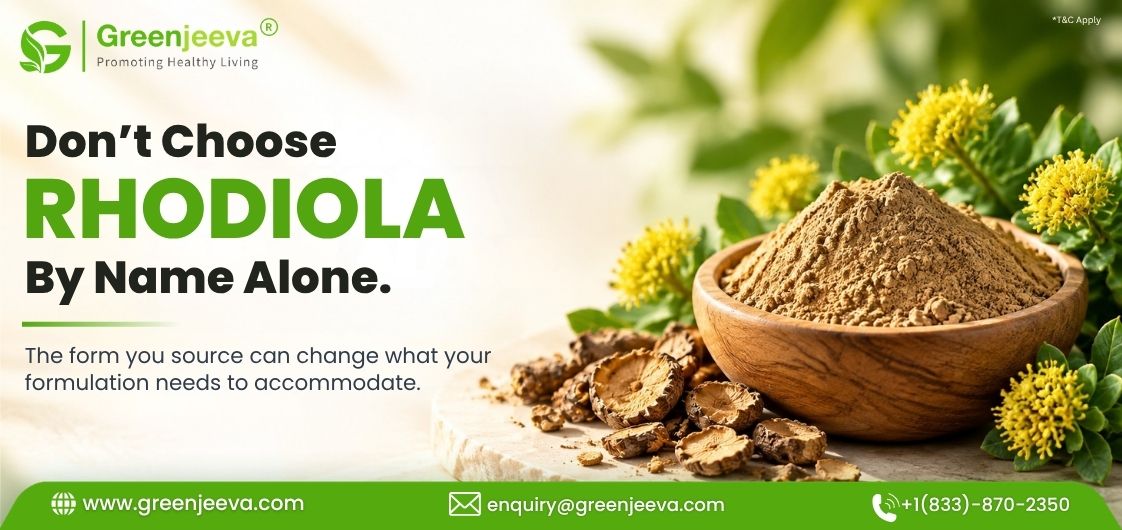
Rhodiola rosea can be supplied to formulators in different forms, with botanical powder and extract being two of the most common.
Although both originate from the same botanical species, they can serve different formulation requirements. The decision is therefore less about choosing one format as universally preferable and more about identifying what the finished product actually requires.
Does the formulation need the botanical in its powdered form? Is serving size a constraint? Does the specification call for an extraction ratio or defined marker compounds? Is organic certification part of the raw-material requirement?
These questions can help R&D and procurement teams determine which Rhodiola rosea ingredient to evaluate.
Start With the Formulation Requirement
The most useful starting point is not the supplier catalog.
It is the formulation brief.
Before requesting samples, define what the ingredient needs to contribute to the finished product and what constraints the manufacturing process creates.
Consider:
- Required serving size
- Dosage form
- Available formulation space
- Powder handling requirements
- Desired botanical format
- Analytical specifications
- Standardization requirements
- Organic requirements
- Target manufacturing cost
Once these parameters are established, the choice of raw material becomes easier to narrow down.
Rhodiola Rosea Powder vs. Extract: The Technical Difference
Rhodiola rosea powder is a powdered botanical material produced from the specified plant material through processes such as drying and milling.
Rhodiola rosea extract undergoes an extraction process designed to transfer selected constituents from the botanical starting material into an extract.
As a result, an extract can provide a more concentrated ingredient and may be specified according to an extraction ratio or particular marker compounds.
The important point for formulators is that these are different raw-material formats, not simply different grades of the same powder.

This distinction should be established before comparing supplier pricing.
When Does a Formulation Call for Rhodiola Rosea Powder?
A powder can be an appropriate format when the product is designed around the botanical material itself and the formulation can accommodate the required quantity.
Whole-botanical formulations
Some products are developed around recognizable botanical ingredients rather than concentrated extracts.
In these cases, a Rhodiola rosea botanical powder may fit the formulation brief more naturally.
The R&D team can then evaluate the ingredient based on its botanical identity, plant part, physical characteristics, quality specifications, and compatibility with the rest of the formula.
Powder-based dosage forms
Physical properties become important when Rhodiola rosea is incorporated into:
- Capsules
- Powder blends
- Sachets
- Drink mixes
- Other dry formulations
Particle size, moisture, bulk density, flow, color, odor, and blend compatibility can all influence how a botanical powder behaves during manufacturing.
The ingredient therefore needs to be assessed as a physical raw material, not just as a botanical name.
Formulations with sufficient ingredient capacity
If the finished product can accommodate the required amount of botanical material, there may be no formulation-driven need to move to a concentrated extract.
The actual requirement depends on the product's intended serving size and the specification of the raw material.
When Does a Formulation Need an Extract?
An extract becomes more relevant when the formulation requires a concentrated botanical ingredient or a defined analytical profile.
Limited serving size
Some dosage forms have strict space constraints.
Capsules, tablets, and combination formulas may have limited capacity for multiple active ingredients. In these situations, the quantity of botanical material required becomes an important development consideration.
A concentrated extract can potentially reduce the physical amount of Rhodiola material needed.
The decision should be based on the actual specification and required formulation quantity rather than price per kilogram alone.
Defined extraction ratio
Botanical extracts may be described using ratios such as 10:1 or 20:1.
The ratio describes the relationship between the amount of starting botanical material and the resulting extract, according to the supplier's defined extraction process.
However, extraction ratio should not be treated as a universal potency measurement.
Two extracts with the same stated ratio can still have different specifications and analytical profiles.
For that reason, R&D teams should review the complete extract specification rather than selecting an ingredient based on the ratio alone.
Specified marker compounds
A formulation may require an extract with a defined level or range of particular marker compounds.
That changes the raw-material requirement considerably.
Instead of simply asking for “Rhodiola rosea extract,” the buyer may need to specify:
- Target marker compounds
- Required concentration or range
- Analytical method
- Extraction ratio
- Extraction process
- Batch testing requirements
This gives the supplier a much clearer technical brief.
Extraction Ratio Is Not Standardization
These terms are sometimes used together, but they describe different aspects of an extract.
Extraction ratio describes the relationship between the starting botanical material and the resulting extract.
Standardization refers to specifying or controlling one or more constituents within the finished extract.
Therefore, an extract with a stated extraction ratio is not automatically standardized to a particular constituent level.
For procurement teams, this distinction is important when comparing different Rhodiola rosea extracts.
The specification should tell you what the extract actually represents.
What Part of the Rhodiola Rosea Plant Is Being Used?
The plant part should be defined regardless of whether the material is supplied as powder or extract.
The scientific identity should be clearly stated as Rhodiola rosea L., while the supplier specification should identify the plant part used.
Common names such as:
- Arctic root
- Golden root
- Rosea root
may appear in commercial descriptions, but they should not replace scientific identification during ingredient qualification.
For R&D and procurement, the relevant question is:
What defined botanical material was used to produce this ingredient?
That information should come from the product specification and supporting documentation.
Where Does Organic Rhodiola Rosea Powder Fit?
For manufacturers developing products around organically sourced botanicals, organic Rhodiola rosea powder can be evaluated as part of the raw-material strategy.
Organic status should be considered alongside the technical requirements rather than separately from them.
For example, a formulation may require:
Rhodiola rosea L. + specified plant part + powder format + organic certification + defined quality parameters.
That creates a much more useful purchasing specification than simply asking for “organic Rhodiola.”
For U.S. products making organic claims, buyers should verify the applicable certification and documentation associated with the ingredient and supply chain.
How Should R&D Compare the Cost?
Comparing botanical ingredients strictly by price per kilogram can produce a misleading result.
Suppose one ingredient has a lower kilogram price but requires substantially more material in the finished formulation.
Another ingredient may cost more per kilogram but require a smaller quantity because it is an extract with a defined concentration.
The more useful calculation is:
Ingredient cost per finished serving
or, depending on the development stage:
Ingredient cost at the required formulation inclusion level.
This allows the team to compare the actual economic impact of the ingredient rather than just the supplier's unit price.
The same approach can be applied when comparing different extracts.
What Should You Ask a Rhodiola Rosea Supplier?
Once the formulation requirement is defined, supplier qualification becomes much more targeted.
For Rhodiola Rosea Powder
Ask for:
- Scientific name
- Plant part
- Country of origin
- Powder specifications
- Particle size
- Moisture
- Microbiological specifications
- Applicable contaminant testing
- Certificate of Analysis
- Organic certification, if required
- Available pack sizes and bulk quantities
For Rhodiola Rosea Extract
In addition to the above, request:
- Extraction ratio
- Extraction method
- Solvent system, where applicable
- Marker compounds
- Standardization details
- Analytical methods
- Specification range
- Batch-specific analytical results
This makes it possible to compare suppliers on technical equivalence rather than simply comparing product names.
What About Rhodiola Rosea Benefits?
“Rhodiola rosea benefits” is a common search phrase, but product development requires a different level of analysis.
For an R&D team, the more actionable questions are:
- What is the raw material?
- Which plant part was used?
- What form is being supplied?
- What does the specification guarantee?
- Is the extract standardized?
- What quantity is required per serving?
- Does the ingredient fit the dosage form?
- What documentation is available?
This shifts the discussion from broad consumer-facing claims to the characteristics that actually matter when selecting an ingredient.
Any finished-product claims should also be evaluated separately against the regulatory requirements applicable to the target market.
A Practical Decision Framework
The decision can be simplified into a few formulation questions.
Choose to evaluate a Rhodiola rosea powder when:
- The formulation is designed around the whole botanical material.
- The required quantity can be accommodated.
- Powder characteristics fit the manufacturing process.
- A concentrated extract is not required by the specification.
- Organic botanical powder is part of the product requirement.
Evaluate an extract when:
- Serving size or formulation space is limited.
- A concentrated botanical ingredient is required.
- The formulation specifies an extraction ratio.
- Defined marker compounds are required.
- Standardization is part of the raw-material specification.
This is not a universal selection rule. The final choice should follow the formulation's technical requirements.
Sourcing Bulk Organic Rhodiola Rosea Powder
Once the formulation team determines that powder is the appropriate format, procurement can move toward supplier qualification.
For bulk organic Rhodiola rosea powder, buyers should evaluate more than availability and price.
The supplier should be able to provide appropriate information regarding:
identity → plant part → organic status → specifications → testing → COA → bulk availability.
For manufacturers searching for a Rhodiola rosea powder supplier in the USA, logistics and supply continuity can also become part of the evaluation.
Questions around MOQ, lead time, sample availability, packaging, inventory, and documentation can help determine whether an ingredient is practical for commercial production.