
Does 80% vs 85% Pea Protein Matter in a Finished Product?
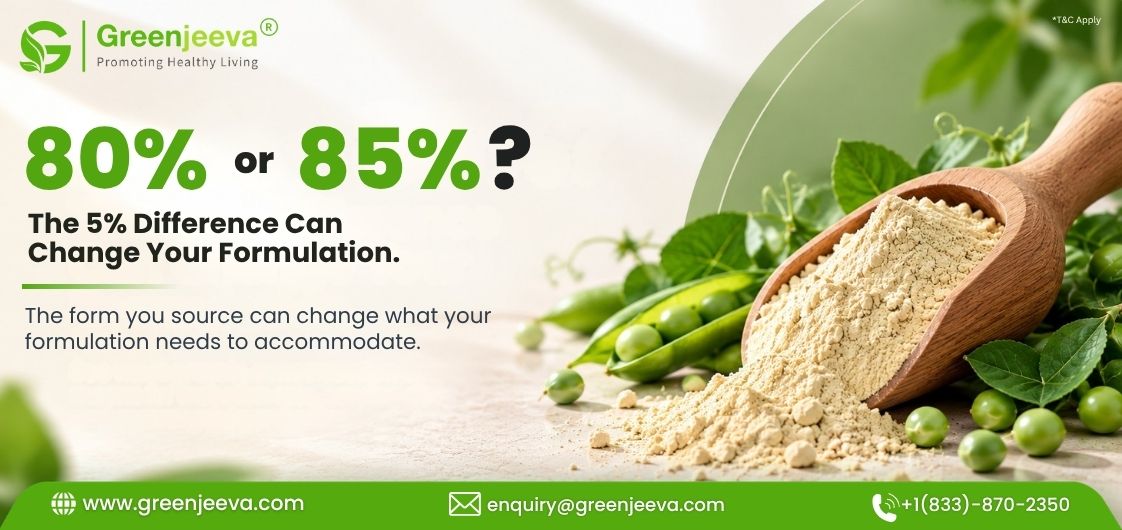
When sourcing organic pea protein powder, the difference between an 80% and 85% specification can look straightforward. One contains more protein, so it is tempting to assume that the Organic Pea Protein Powder 85% grade is automatically the better choice.
For manufacturers, the more useful question is
What does that five-percentage-point difference change in the finished product?
The answer depends on the formulation. Protein concentration affects protein contribution and inclusion rates, but it is only one part of the ingredient specification.
What Does 80% vs. 85% Pea Protein Mean?
The percentage indicates the protein concentration stated in the ingredient specification.
At the same inclusion rate, an 85% grade contributes more protein than an 80% grade.

That is a 1.25 g difference in protein per 25 g of ingredient.
The calculation becomes more useful when working backward from a protein target.
To provide 20 g of protein:
- 80% grade: 20 ÷ 0.80 = 25 g ingredient
- 85% grade: 20 ÷ 0.85 = 23.5 g ingredient
So, the 85% grade requires approximately 1.5 g less ingredient to deliver the same 20 g of protein.
For a commercial formulation, that can affect ingredient inclusion, serving size and cost calculations.
But protein concentration alone does not determine whether one grade is the right fit.
What Else Should Manufacturers Compare?
A higher protein percentage does not automatically mean better formulation performance. Organic Pea Protein Powder 80%
When comparing and 85% pea protein, manufacturers should review the complete specification.
Protein concentration
Confirm the stated protein percentage and testing basis. This is essential for calculating protein contribution to the finished product.
Moisture, ash, fat and carbohydrate
The non-protein fraction can differ between grades and suppliers. These values can affect nutritional calculations and the overall formulation.
Particle characteristics
Particle size and powder handling can influence blending and processing, particularly in dry formulations.
Sensory characteristics
Pea protein has a characteristic plant-protein profile. Flavor and odor should be evaluated in the finished application rather than inferred from protein concentration.
Quality and certification
Review microbiological and contaminant specifications, organic certification where applicable, COA requirements and lot traceability.
The protein percentage tells you how concentrated the protein is. The complete specification tells you what you are buying.
Does 85% Pea Protein Perform Better?
Not necessarily.
An 85% grade may allow a manufacturer to reach a protein target with less ingredient, but protein concentration alone does not establish better solubility, dispersion, texture, flavor or processing performance.
Those characteristics need to be assessed from the actual specification and, where necessary, application testing.
This is particularly important when moving from an R&D sample to commercial production. The grade approved during product development should match the specification intended for the production supply.
Which Grade Fits Your Formulation?
The simplest way to decide is to start with the finished-product requirement.

This prevents manufacturers from choosing a grade based solely on the headline protein number or price per kilogram.
What Should Manufacturers Check Before Buying Bulk Pea Protein Powder?
Once the formulation team identifies the appropriate grade, procurement needs to determine whether the supplier can support commercial production.
When evaluating bulk pea protein powder, check:
- Product specification and protein assay
- Current COA and quality documentation
- Organic certification, where applicable
- Microbiological and contaminant testing
- Batch and lot traceability
- Available bulk quantities
- Inventory location
- Lead time
- Packaging options
- Repeat-order availability
The sample should also represent the commercial grade being considered.
A successful R&D trial is useful only if the same specification can be supplied consistently when the product moves into production.
Also read: The Ultimate Comparison of Plant-Based Protein Powders
Your Complete Guide to Pea Protein Powder
What Should You Ask a Pea Protein Supplier in the USA?
For manufacturers evaluating a pea protein supplier in USA, ask:
- Are both 80% and 85% grades available?
- Are organic grades available?
- What is the protein testing basis?
- Can the current specification and COA be provided?
- What quality and contaminant testing is performed?
- Is organic certification available?
- What bulk quantities are supported?
- Where is inventory held?
- Can the same grade be supplied for repeat production?
- Can R&D samples be sourced from the commercial grade?
These questions help procurement evaluate the ingredient as a production input, rather than simply comparing supplier prices.
Sourcing Organic Pea Protein for Commercial Production
Green Jeeva offers organic pea protein 80% and 85%, giving manufacturers the opportunity to evaluate both specifications against their formulation requirements.
For R&D teams, the choice can start with the protein target, serving size and application requirements.
For procurement teams, the next step is confirming that the selected grade can be supported with the required documentation, bulk quantities, and repeat supply.
When moving from an approved sample to bulk pea protein powder, both the ingredient specification and the supplier's ability to maintain that specification at a commercial scale matter.
The Bottom Line
The difference between 80% and 85% organic pea protein powder matters when it changes the amount of ingredient required to meet a formulation's protein target.
But protein concentration is only one part of the decision.
Manufacturers should compare the complete specification, application requirements, documentation, and commercial supply capability before selecting a grade.
Green Jeeva's organic 80% and 85% pea protein options give manufacturers a choice based on their specific formulation and production requirements.