

How Is Organic Irish Moss Powder Made? A Look at Chondrus crispus Processing
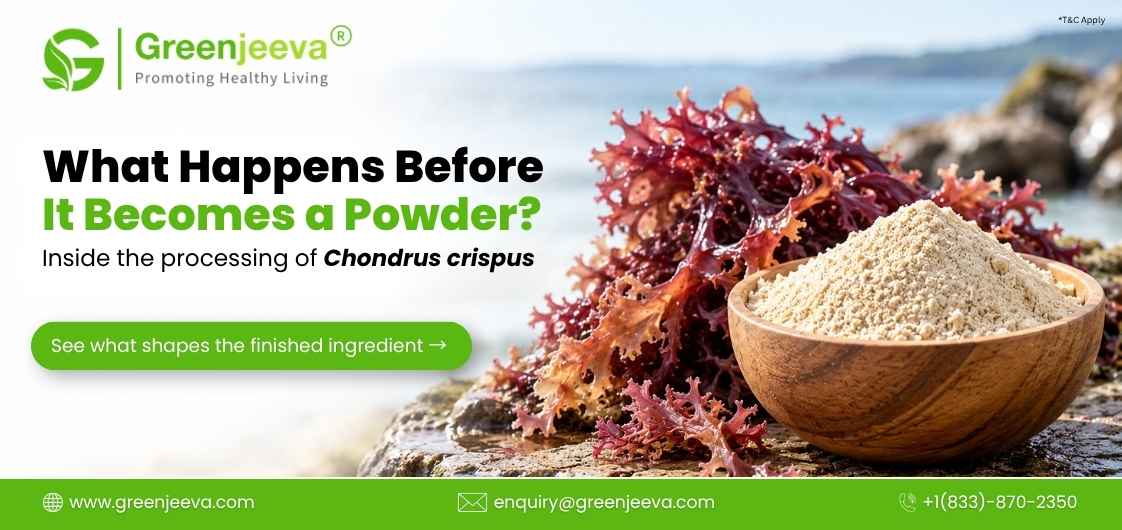
A pile of freshly harvested seaweed and a bag of fine Irish moss powder hardly look like the same ingredient.
But they are.
Between those two forms, Chondrus crispus goes through a series of steps that turn a marine raw material into a practical powdered ingredient. It is cleaned, dried, milled, and, when required, sieved to achieve a defined particle size.
The process sounds simple. The finished ingredient is anything but.
“Organic Irish moss powder” tells you what the material looks like at the end. It doesn't tell you how the seaweed was handled, how it was dried, how finely it was milled, or what specifications define the finished powder.
Understanding that journey makes it easier to see what is behind the ingredient name and why processing matters when the powder moves into a formulation.
What Is the Raw Material Behind Irish Moss Powder?
Organic Irish moss powder starts with Chondrus crispus, a species of red algae commonly known as Irish moss.
That botanical identity is important because terms such as “sea moss,” “seaweed powder,” and “red algae powder” can describe a much broader range of marine ingredients. Chondrus crispus identifies the particular species being used.
For a whole-seaweed powder, the starting material is the seaweed thallus. Rather than extracting and concentrating a particular fraction, the seaweed itself is dried and processed into powder.
Green Jeeva's Organic Irish Moss Powder is described as whole Chondrus crispus seaweed, with washing, drying, and fine grinding listed as the processing method.
So, before there is a powder, there is the raw seaweed.
And that raw material needs to be prepared before it can become one.
What Happens After Chondrus crispus Is Harvested?
Freshly harvested seaweed isn't ready to go straight into a mill.
As a marine raw material, it can carry sand, shells, surface material, and other unwanted matter from harvesting and handling. Cleaning and sorting therefore come before the drying and milling stages.
Washing helps remove this unwanted material and prepares the seaweed for further processing. Research on Chondrus crispus has also examined the effect of washing on the characteristics of the seaweed, showing that this step can influence the material before it moves further down the processing line.
Once the seaweed has been cleaned, the next challenge is moisture.
Fresh marine biomass contains a substantial amount of water. Before it can be stored and milled into a stable powder, that moisture needs to be reduced.
Why Is Drying an Important Step in Making Irish Moss Powder?
Drying is where Chondrus crispus starts to take on the form of a dry ingredient.
The objective isn't simply to make the seaweed feel dry. The resulting material needs to be suitable for milling, packaging, transport, and storage.
That makes moisture an important part of the finished ingredient specification.
Drying also prepares the seaweed for the next stage. Once the material has been sufficiently dried, it becomes brittle enough to be mechanically reduced into smaller particles.
And that is where the word "powder" starts to become more meaningful.
How Does Chondrus crispus Become a Consistent Powder?
Grinding dried seaweed into smaller particles sounds straightforward. But not every powder has the same particle-size profile.
Milling reduces the dried Chondrus crispus into smaller particles, while sieving or other classification methods can be used when a more defined size range is required.
Research on Chondrus crispus has examined different particle-size fractions produced through mechanical milling. The study found that reducing particle size increased the surface area of the resulting material, demonstrating that particle size can change the physical characteristics of the powder.
That matters when the ingredient moves from a raw material into a formulation.
A finer powder may behave differently during blending, dispersion, handling, or incorporation than a coarser material. For that reason, commercial specifications may include a mesh size or particle-size range rather than simply describing the product as “fine powder.”
So, the processing journey begins to look like this:
cleaned seaweed → dried seaweed → milled material → defined particle size → finished powder
Every stage contributes to the material that eventually reaches the manufacturer.

What Does Processing Tell You About the Finished Irish Moss Ingredient?
Once processing is complete, the powder can be evaluated against its finished specification.
This is where the different stages start to come together.
Botanical identity
The first question is straightforward: what is the ingredient?
For Irish moss powder, the expected botanical identity is Chondrus crispus. A broader term such as “sea moss” does not provide the same level of specificity.
Moisture
The drying process and the finished moisture specification are closely connected.
The final powder needs to meet the applicable moisture requirement for its intended use and storage conditions.
Particle size
The word “powder” doesn't tell you exactly how fine the material is.
A defined mesh or particle-size range provides a clearer description of the physical form and can be important when an ingredient needs to perform consistently within a manufacturing process.
Appearance
Color and general appearance can be useful during incoming material checks. They can help identify obvious differences between batches, although appearance alone cannot establish botanical identity or overall quality.
Documentation
Then there is the information that accompanies the ingredient.
Depending on the application and supplier, this may include a product specification, certificate of analysis, organic certification, and applicable microbiological or contaminant testing.
Together, these details provide a much clearer picture of the finished Irish moss ingredient than the product name alone.
Organic Irish Moss Powder Is Not the Same as Irish Moss Extract
There is another distinction worth making because these two ingredient forms can easily be grouped together.
A whole-seaweed Irish moss powder is made by drying and milling the seaweed itself. An Irish moss extract powder goes through additional processing to obtain a concentrated fraction or specific constituents.
The botanical name may be the same, but the finished ingredients are not necessarily interchangeable.
Green Jeeva's Organic Irish Moss Powder is identified as whole Chondrus crispus seaweed, with washing, drying, and fine grinding listed as the processing method.
For formulation work, that difference matters. Chondrus crispus powder
If a product specification calls for it, substituting an extract simply because both originate from the same species can change the physical characteristics and formulation behavior of the ingredient.
The form of the ingredient is part of its identity.
Where Does Irish Moss Powder Fit Into Formulations?
Once processed, Irish moss powder can be used in food, beverage, functional food, and selected personal care formulations where a whole-seaweed ingredient is appropriate.
Applications can include:
- Plant-based food products
- Beverage and powdered drink formulations
- Sauces and soups
- Bakery and dessert applications
- Functional food formulations
- Selected personal care formulations
But knowing where an ingredient can be used is only the beginning.
A product developer may need a particular particle size. Another may need organic certification and specific documentation. At a production scale, consistency between batches may become just as important as how the powder performs in an initial trial.
So, the more useful question isn't simply:
Can Irish moss powder be used in this product?
It is:
Does this particular Irish moss powder fit the formulation and manufacturing process?
That question naturally leads back to the ingredient specification.
What Should You Consider When Sourcing Organic Irish Moss Powder in Bulk?
For teams looking to buy organic Irish moss powder in bulk, understanding the processing route gives useful context for evaluating the finished material.
Start with identity.
Is the ingredient Chondrus crispus?
Then look at the form.
Is it whole-seaweed powder or an extract? If it is a powder, what particle-size or mesh specification does it meet?
Next, consider the processing information.
How was the raw material cleaned and dried? How was it milled? Does the supplier provide a clear specification for the finished ingredient?
The documentation should support those answers.
Depending on the intended application, manufacturers may need access to:
- Botanical identity
- Product specification
- Particle-size or mesh information
- Certificate of analysis
- Organic certification
- Applicable microbiological and contaminant testing
- Batch and traceability information
For an organic Chondrus crispus powder supplier, being able to provide this information gives manufacturers a clearer basis for evaluating the ingredient.
It also becomes increasingly important when a material moves from a small formulation trial into regular bulk production.
The Powder Is Only the Final Step
Irish moss powder may look simple once it has been milled and packed.
Its story starts much earlier.
The raw Chondrus crispus has to be cleaned, dried, and reduced to the required particle size before it becomes the finished powder. Each stage contributes to the physical characteristics and specifications of the final ingredient.
That is why two products carrying the same ingredient name can still differ in particle size, moisture, appearance, documentation, and other specifications.
For anyone working with organic sea moss powder, Irish moss ingredient, or Chondrus crispus powder, looking beyond the product name can provide a much clearer understanding of what is being supplied.
And for manufacturers evaluating bulk Irish moss powder for formulations, that understanding can make the move from ingredient selection to production a much more informed one.
Looking for Organic Irish Moss Powder in Bulk?
Green Jeeva supplies Organic Irish Moss Powder made from Chondrus crispus whole seaweed. The listed processing method includes washing, drying, and fine grinding.
If you're looking for a wholesale organic Irish moss powder supplier for manufacturing or formulation needs, review the ingredient specification and supporting documentation alongside your application requirements.
Need organic Irish moss powder for your next formulation? Request a sample and review the specification with your team.