

Organic Brown Rice Protein Powder 80%: How Global Brands Use It in Supplements and RTDs
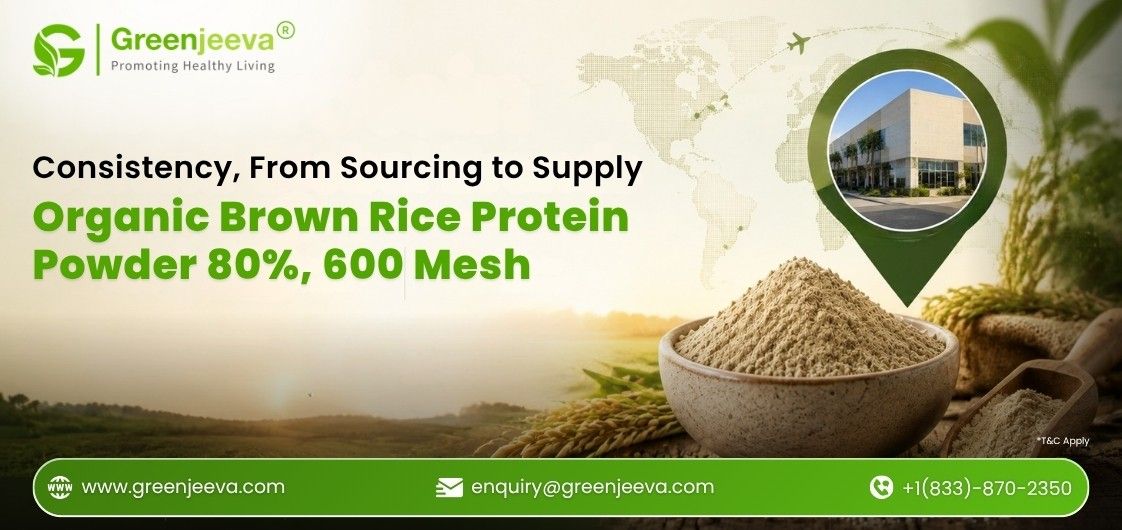
Organic Brown Rice Protein Powder 80%, 600 Mesh, has become a go-to plant-based input for brands formulating supplements, ready-to-drink beverages, functional foods, personal care, and specialized nutrition. This guide covers how it is made, where global brands use it, what procurement teams should verify, and how to buy bulk organic brown rice protein powder in the USA with confidence.
What Defines Organic Brown Rice Protein Powder 80%, 600 Mesh?
Organic brown rice protein powder 80% is produced from whole brown rice grown on certified organic farms, then processed to isolate a protein-rich fraction that is dried and milled to a fine, consistent particle size. The 600 mesh grade disperses smoothly in both wet and dry systems, making it a reliable choice for beverages, powdered blends, and personal care bases.
Unlike commodity-grade rice protein, this specification of bulk organic brown rice protein powder is built around traceability, clean processing, and documentation that supports USDA organic brown rice protein powder and non-GMO labeling claims. Green Jeeva sources and processes its organic brown rice protein bulk USA supply with full certificate traceability from farm to finished lot, which is verified against USDA National Organic Program standards and cross-checked through Non-GMO Project verification protocols.
Enzymatic Extraction vs. Mechanical Extraction: Why It Matters
Enzymatic extraction separates protein from starch and fiber using targeted enzymes rather than heat or solvents, and it typically produces a smoother, more neutral-tasting protein than mechanical extraction methods. This matters for formulators because enzymatic processing preserves amino acid integrity, reduces off-flavors, and supports the clean-label, minimal-processing claims that buyers increasingly require. Green Jeeva's enzymatic process is documented and available for review during supplier qualification.
How Do Its Functional Properties Support High-Performance Formulations?
Particle flowability and dispersion capacity, water-binding and emulsion support, and thermal stability during pasteurization are the three functional properties that most directly determine how well organic brown rice protein performs in large-scale production. Together they give formulators predictable behavior across beverages, bars, and dry blends, which reduces reformulation cycles and batch failures.
Key functional traits include:
• Fine dispersion capacity from the 600 mesh particle size, which reduces grittiness in beverages and dry mixes.
• Water-binding ability, supporting viscosity and body in shakes, bars, purees, and functional foods.
• Emulsion support, useful in plant-based meal replacements and creamy systems.
• Thermal stability, reducing clumping or destabilization during pasteurization or extrusion.
• Neutral sensory impact, allowing higher inclusion rates without overpowering flavor.
Because organic brown rice protein powder carries minimal off-flavors, it blends well with natural sweeteners, flavor systems, and functional inclusions, which is part of why it pairs so effectively in multi-protein blends. For a closer look at how it stacks up against other protein sources, see our comparison in Bulk Whey Protein vs Plant Protein: Which Protein Source Delivers Better Consistency?
How Does Organic Brown Rice Protein Compare to Pea, Soy, and Whey?
Organic brown rice protein offers a hypoallergenic, non-dairy, non-soy alternative with strong dispersibility, while pea, soy, and whey each bring different strengths and trade-offs depending on the formulation goal. The table below summarizes how the four sources compare on the factors procurement and R&D teams weigh most often.

Brands frequently blend organic brown rice protein with pea, pumpkin seed, or hemp protein to balance amino acid profiles and achieve a smoother finished product than any single source alone.
Where Do Global Brands Use This Ingredient Across Supplements, Foods, and RTDs?
Manufacturers rely on organic brown rice protein powder 80%, 600 mesh across several high-volume formulation categories, from protein powders to personal care.
Nutraceutical and Dietary Supplement Powders: Blended with pea, pumpkin seed, or hemp proteins, it supports plant-based protein mixes, amino acid blends, and sports-focused powders that need clean-label statements and consistent scoop-to-scoop distribution.
Ready-to-Drink (RTD) and Ready-to-Mix (RTM) Beverages: Brands developing shakes, meal-replacement beverages, and hydration-plus-protein systems use this plant-based protein for RTD beverages to raise plant protein content without sedimentation. Its dispersion and stability hold up through high-shear mixing, UHT processing, and homogenization, which is why more organic brown rice protein for RTD manufacturers projects are moving toward this specification.
Functional Foods and Plant-Based Snacks: Protein bars, baked goods, extruded snacks, and instant porridge mixes use this rice protein for functional foods for both protein contribution and structural support during extrusion.
Personal Care and Cosmetic Formulations: Manufacturers use rice protein in masks, creams, and hair serums for viscosity, film-forming properties, and label-friendly claims.
Pet and Animal Nutrition: Formulators use rice-based protein systems in pet nutrition for plant-derived sourcing and stable performance in dry and semi-moist products.
If your formulation team is exploring adjacent clean-label ingredient categories, our article on Personalized Nutrition: Clean Label Ingredients in Tailored Functional Food Solutions covers how plant-based proteins fit into broader clean-label strategy.
What Should Procurement Teams Check Before Buying in Bulk?
Procurement teams sourcing organic brown rice protein bulk USA, or for other regions, should request full documentation before committing to a purchase order, not generic spec sheets. The checklist below covers the certificates, test reports, and technical confirmations that matter most.
• USDA Organic Certificate, compliant with the USDA National Organic Program
• Non-GMO documentation, ideally Non-GMO Project verified
• Heavy metal testing with region-specific limits (USA, EU, AUS)
• Microbiology profile covering pathogens, plate counts, yeast, and mold, tested to standards consistent with NSF International protocols
• Allergen statement confirming absence of common allergens
• Residual solvent report, where applicable
• Pesticide residue testing aligned with organic regulations
• Batch-specific Certificate of Analysis (COA), not a generic specification sheet
• Mesh size confirmation for the 600 mesh requirement
• Moisture and protein content verification
Buyers should request COA and samples for rice protein powder, along with MSDS, the Organic Certificate, nutritional data, and microbial test results, before finalizing an order. Working with an organic brown rice protein powder supplier that holds USA warehouse presence shortens lead times and supports consistent lot-to-lot uniformity across quarterly or annual production cycles. For a broader view of what to vet in any bulk ingredient partner, see How Your Favorite Health Products Are Made: The Story Behind Sourcing Bulk Ingredients.

What Are Lesser-Known Technical Details Buyers Should Know?
A handful of technical details rarely get discussed but matter for large-scale buyers. Particle flowability improves blending performance in high-throughput ribbon and paddle mixers, enzymatic extraction tends to produce a smoother sensory result than mechanical extraction, and regulatory acceptance across the USA, EU, Canada, and Australia simplifies dossier preparation for multi-region launches. Low ash and fat levels also support stability during longer storage cycles in hot or humid climates, which matters for brands shipping to tropical markets.
How Are Market Trends Shaping Demand for Organic Rice Protein in 2026?
Demand for USDA organic brown rice protein powder is rising across the USA, Canada, India, the EU, Australia, and the UK, driven by growth in plant-based beverages and bars, rising interest in clean-label and non-GMO systems, and expanding use in personal care and specialized nutrition. R&D teams are increasingly combining rice protein with other plant proteins to fine-tune sensory attributes, viscosity, and dispersibility, and fine-mesh variants like 600 mesh are becoming the default choice for high-speed filling and continuous mixing systems.
Pricing and Availability
Pricing for organic brown rice protein powder 80% varies by mesh grade, certification level, and order volume. Green Jeeva maintains standing USA warehouse inventory and offers volume-based pricing tiers for bulk organic brown rice protein powder orders. Register now to view current pricing, request a sample, and download the full COA and certification package.
Conclusion
Organic Brown Rice Protein Powder 80%, 600 Mesh, continues to expand across supplements, RTDs, functional foods, cosmetics, and specialized nutrition because of its predictable performance, fine particle size, and compatibility with clean-label strategies. For procurement teams, the priorities are documentation, compliance, testing transparency, and supply chain readiness. For formulators, ease of integration across wet and dry systems makes it a flexible option for global product development.
If your team is evaluating organic brown rice protein powder for an upcoming formulation or bulk production run, register now to view products and get direct access to specifications, COAs, and free sample requests.
This statement has not been evaluated by the Food and Drug Administration. This product is not intended to diagnose, treat, cure, or prevent any disease.