

Bulk Pineapple Juice Powder: Managing Stickiness, Carrier Systems, and Scale-Up Performance in U.S. Manufacturing
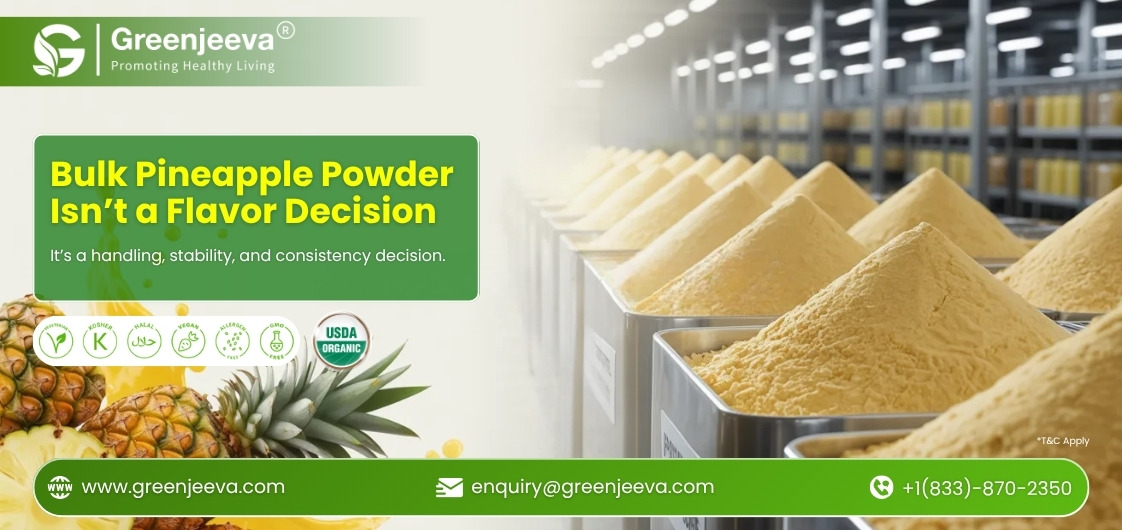
Demand for pineapple powder continues to grow across U.S. food, beverage, and nutraceutical manufacturing. From hydration blends and functional beverages to flavor systems and nutrition powders, pineapple-derived ingredients are widely used for their flavor profile, versatility, and consumer familiarity.
At the formulation stage, these ingredients appear easy to work with.
They disperse well in small batches, align with clean-label positioning, and integrate smoothly into early prototypes. Product development teams often validate them quickly without significant resistance.
However, experienced formulation and procurement teams recognize a different reality:
Pineapple-based powders that perform well in lab trials may behave very differently at production scale.
In bulk manufacturing environments, performance is influenced by moisture interaction, carrier systems, processing conditions, and storage behavior over time not just ingredient identity.
What Is Pineapple Juice Powder?
Pineapple juice powder is a spray-dried ingredient derived from pineapple juice solids, typically stabilized using carrier systems to improve drying efficiency, flowability, and shelf stability.
It is commonly used in:
- beverage and hydration mixes
- nutraceutical formulations
- functional food products
- dry flavor systems
Compared to whole fruit formats, juice-based powders are designed for better dispersion and process compatibility, especially in dry blending systems.
However, this processing introduces additional variables that influence performance during scale.
Pineapple Formats in Supply: Why Selection Matters Early
In commercial sourcing, multiple pineapple-derived formats exist:
- pineapple fruit powder
- pineapple juice powder
- pineapple extract powder
- pineapple concentrate powder
These formats are often treated interchangeably in sourcing discussions, but they behave differently in formulations.
For example:
- fruit-based powders → thicker texture, fiber presence
- juice-derived powders → lighter structure, improved dispersion
- extract formats → targeted functionality
For procurement teams evaluating Bulk Pineapple Fruit Juice Powder, selecting the correct format early helps prevent:
- formulation imbalance
- texture inconsistency
- rework during scale-up
This decision becomes particularly important in multi-ingredient systems where powder behavior affects the entire formulation.

Hygroscopic Behavior: The Core Challenge in Pineapple Powder Programs
One of the most critical and often underestimated factors in pineapple powder bulk programs is hygroscopicity.
Pineapple-derived powders naturally absorb moisture from the surrounding environment. In controlled lab conditions, this behavior is often minimal and manageable.
At scale, however, it becomes operational.
What Changes in Production:
- exposure to ambient humidity
- longer storage durations
- larger packaging formats
- repeated handling cycles
What Teams Begin to See:
- clumping in storage
- caking inside packaging
- reduced flow during blending
- hopper discharge inconsistencies
In U.S. manufacturing environments especially across regions with varying humidity levels—this behavior becomes more pronounced over time.
Procurement teams sourcing bulk pineapple powder therefore evaluate:
- packaging barrier properties
- moisture control during storage
- warehouse environmental conditions
Because once clumping begins, it affects both efficiency and product consistency.
Carrier Systems: The Hidden Driver of Powder Performance
Most pineapple juice powder products rely on carrier systems commonly maltodextrin to stabilize spray drying and improve handling.
This introduces a key formulation trade-off.
What Carriers Improve:
- flowability
- powder stability
- reduced stickiness
- extended shelf life
What Carriers Influence:
- sweetness perception
- flavor intensity
- label claims
- formulation balance
For buyers sourcing:
- Non-GMO pineapple juice powder
- Gluten-free pineapple juice powder
- Vegan pineapple powder
carrier composition becomes a critical part of supplier evaluation.
Even small variations in carrier percentage can lead to:
- flavor differences
- solubility variation
- inconsistent batch performance
This is why experienced procurement teams evaluate carrier consistency across lots, not just presence.

Solubility vs Dispersion: The Practical Difference
Suppliers often position Pure Pineapple Juice Powder based on solubility.
However, in real manufacturing systems, teams evaluate something more practical:
how the powder behaves during mixing and processing
Differences Observed at Scale:
- slower dispersion in large batch systems
- sediment formation in cold applications
- uneven distribution in multi-ingredient blends
For beverage and nutraceutical formulations, this distinction becomes critical.
A powder that dissolves well in controlled testing may still require:
- longer mixing times
- additional agitation
- formulation adjustments
This is where formulation performance diverges from specification claims.
Sample vs Bulk: Where Procurement Risk Emerges
One of the most common friction points in sourcing is the difference between sample performance and bulk behavior.
During evaluation, samples are:
- freshly produced
- handled in controlled environments
- tested in small batches
In bulk programs, conditions change:
- longer storage durations
- exposure to varying environments
- repeated handling
What Procurement Teams Often Encounter:
- clumping not seen in samples
- changes in flow behavior
- variation in dispersion
- differences betweeninitialand repeat shipments
This is why experienced buyers evaluate not just samples but consistency across shipments.

Shelf-Life and Storage Reality
Shelf-life stability for pineapple-based powders is closely tied to:
- moisture exposure
- packaging quality
- storage conditions
Over time, even well-processed powders may show:
- increased caking tendency
- reduced flowability
- slight sensory changes
For manufacturers sourcing pineapple powder bulk, this creates an operational consideration:
How does the ingredient behave after 30, 60, or 90 days—not just at receipt?
This is particularly important for:
- contract manufacturers
- large batch production
- multi-SKU operations
Because storage behavior directly affects production efficiency.
Supplier Evaluation in Bulk Pineapple Programs
As organizations move into long-term sourcing, supplier evaluation becomes more structured.
Procurement teams evaluating a Pineapple Fruit Juice Powder Supplier often assess:
- consistency of carrier systems
- moisture control practices
- documentation response time
- lot-to-lot similarity
- U.S. inventory availability
For companies sourcing:
- Pineapple Powder in Bulk
- Bulk Pineapple Fruit Juice Powder
- Certified Pineapple Juice Powder
supplier reliability becomes a key factor in maintaining production continuity.
Documentation and Certification Expectations
In U.S. manufacturing environments, documentation plays a critical role in raw material approval.
Suppliers offering:
- USDA Pineapple Fruit Juice Powder
- Non-GMO pineapple juice powder
- Gluten-free pineapple juice powder
Are expected to provide:
- Certificates of Analysis (COA)
- certification documentation
- consistent batch records
Because delays in documentation can impact production timelines as much as ingredient performance issues.
Final Perspective
Pineapple-derived powders are widely used across modern formulations, but their behavior is shaped by more than fruit origin.
For companies sourcing:
- pineapple powder bulk
- Pineapple Juice Powder Supplier USA
- Bulk Pineapple Fruit Juice Powder
the real evaluation lies in:
- moisture behavior over time
- carrier system consistency
- performance under production conditions
Because in large-scale manufacturing:
The challenge is not sourcing pineapple.
It is ensuring that the ingredient performs consistently across batches, environments, and production cycles.