
Bulk Organic Psyllium Husk Powder Buyers Guide to Quality
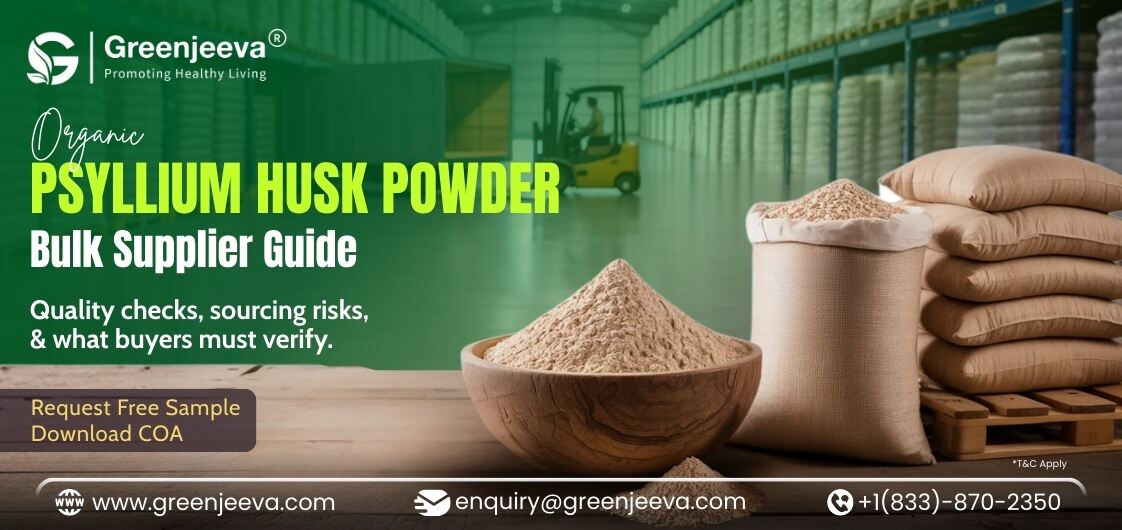
Sourcing organic psyllium husk powder in bulk may appear straightforward, but many procurement teams discover quality issues only after scale-up during microbial testing, formulation trials, or regulatory review. Inconsistent husk purity, variable swelling capacity, and incomplete documentation are common challenges that surface when suppliers are evaluated only on price or origin claims.
For bulk buyers supplying regulated markets, psyllium husk quality is not just a raw material concern it directly affects product performance, compliance timelines, and long-term supply reliability.
This guide is written for procurement managers, formulators, R&D leads, and sourcing teams who need to evaluate organic psyllium husk powder, bulk psyllium husks, and bulk psyllium powder using clear, buyer-centric criteria.
What Defines High-Quality Organic Psyllium Husk Powder?
High-quality organic psyllium husk powder 95% begins with botanical integrity and controlled processing. From a bulk sourcing perspective, quality is defined by purity, hydration behavior, and batch consistency, not appearance alone.
Key characteristics include:
- Husk purity
Premium material should contain clean, well-separated husks with minimal foreign matter or residual seed content. Lower purity affects swelling index and viscosity.
- Controlled grinding
Uniform milling ensures consistent hydration and predictable behavior in formulations, especially in capsules, tablets, and fiber blends.
- High swelling capacity
Swelling index is a functional indicator of psyllium performance. Variability across batches can disrupt formulation consistency.
- Stable moisture levels
Excess moisture increases microbial risk and reduces shelf stability in bulk storage.
For bulk buyers, these parameters must be verified through testing and documentation, not assumed.

Why Bulk Psyllium Buyers Must Evaluate Quality Differently
When sourcing bulk psyllium husks or bulk psyllium powder, small quality deviations can quickly become operational risks.
Common bulk-level challenges include:
- inconsistent swelling index across lots,
- microbial failures during QA,
- changes in powder flow affecting encapsulation,
- documentation gaps delaying regulatory approvals.
Unlike small-batch procurement, bulk sourcing amplifies these risks across production cycles. Once psyllium husk powder is integrated into a formulation, replacing a supplier can mean revalidation, reformulation, and production delays.
This is why bulk buyers must assess suppliers based on process control, documentation readiness, and long-term consistency, not just initial samples.
Key Quality Parameters Buyers Should Verify Before Sourcing
Before approving any organic psyllium husk powder supplier, procurement teams should verify the following at a batch level:
Botanical Identity
- Confirm Plantago ovata husk origin.
- Organic certification should apply specifically to the husk material.
Husk Purity
- Low extraneous matter content.
- Consistent particle profile after milling.
Swelling Index
- Verified swelling capacity aligned with application requirements.
- Consistency across batches is critical for fiber-based formulations.
Moisture & Microbial Limits
- Controlled moisture levels to prevent spoilage.
- Testing for total plate count, yeast, mold, and pathogens.
Heavy Metals & Residues
- Lead, arsenic, cadmium, and mercury testing.
- Residue testing aligned with organic standards.
Batch-Specific Documentation
- Certificate of Analysis (COA) per lot.
- Traceability records from origin to processing.
- Retained samples for verification.
This checklist is where many bulk psyllium powder suppliers fail to meet buyer expectations.
Certifications & Compliance Expectations for Organic Psyllium Husk
For buyers sourcing organic psyllium husk, certification and compliance are essential not optional.
Bulk buyers typically expect:
- USDA Organic certification or equivalent.
- Non-GMO status where required by downstream brands.
- Allergen statements confirming handling conditions.
- FSMA-aligned food safety practices for U.S. market supply.
A reliable supplier should be able to provide these documents before onboarding, not after repeated follow-ups.
Choosing the Right Organic Psyllium Husk Powder Supplier
Not all suppliers offering psyllium husk operate at the same level of control. When evaluating a bulk psyllium powder supplier, buyers should look beyond pricing and availability.
Key evaluation criteria include:
- Supply chain transparency
Clear visibility into sourcing regions, harvest practices, and processing controls.
- Manufacturing discipline
Consistent husk cleaning, milling, and batch segregation.
- Quality assurance systems
Routine testing protocols with batch-level traceability.
- Scalability & reliability
Ability to support repeat bulk orders without quality drift.
For buyers serving regulated markets, working with an organic psyllium husk powder supplier in the USA or North America can simplify compliance workflows and reduce lead-time risks.
Applications That Demand Consistent Psyllium Quality
High-quality organic psyllium husk powder is widely used across B2B formulations where functional performance must remain consistent.
Common applications include:
- Dietary supplements
Capsules, tablets, and powdered fiber blends.
- Functional foods
Baked goods, nutrition mixes, and meal replacements.
- Beverage formulations
Fiber-enriched drink mixes requiring predictable hydration behavior.
Across all applications, inconsistent psyllium quality can affect texture, stability, and dosage accuracy, making supplier reliability critical.
Bulk Psyllium Husks vs Bulk Psyllium Powder: What Buyers Should Know
Bulk buyers often evaluate both bulk psyllium husks and bulk psyllium powder depending on processing needs.
- Bulk psyllium husks are typically used where in-house milling or specific particle control is required.
- Bulk psyllium powder offers convenience and consistency for direct formulation use but requires tighter control over milling and moisture.
In both cases, quality verification and documentation standards remain the same.

Final Takeaway for Bulk Buyers
Sourcing organic psyllium husk powder is not a commodity decision it is a process-driven procurement choice.
For buyers focused on long-term formulation stability and regulatory confidence, success depends on:
- verifying functional quality indicators,
- demanding batch-level documentation,
- and selecting suppliers built for bulk, repeatable supply.
Evaluating psyllium suppliers through this lens helps reduce risk, improve consistency, and support scalable growth across supplement, food, and functional nutrition applications.