
Ultimate Guide: How to Source Bulk Organic Jerusalem Artichoke Powder (90% Inulin) for Food & Supplement Formulations
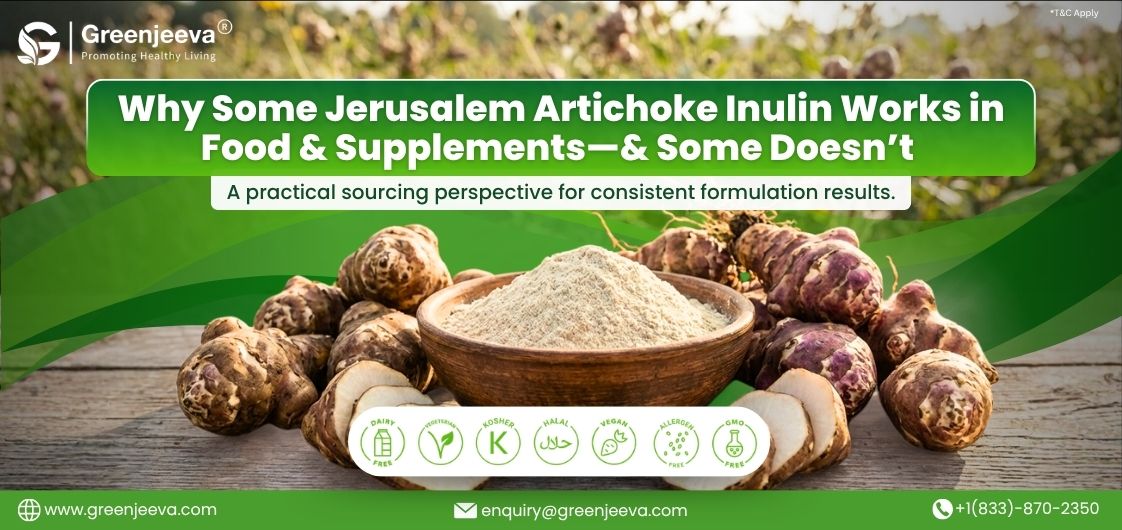
Why Sourcing Jerusalem Artichoke Inulin Powder Is Not as Straightforward as It Looks
Two batches. Same supplier. Same spec. One works. One doesn’t.
This is where most sourcing decisions break.
At a glance, sourcing bulk organic Jerusalem artichoke powder (90% inulin) appears simple. Most suppliers present similar certifications, comparable COAs, and nearly identical purity claims. Pricing often falls within a narrow range, which makes it easy to assume that the material is interchangeable.
But once the ingredient enters formulation, those assumptions start to fall apart.
One batch of jerusalem artichoke inulin powder integrates smoothly into a beverage system. Another introduces haze or sedimentation. In powder blends, differences show up as uneven dispersion or subtle changes in mouthfeel. In finished products, these variations can extend to sensory experience and even digestive tolerance.
This is where specs stop helping and real performance starts to matter.
For teams evaluating a bulk Jerusalem artichoke powder USA supplier, the key question is no longer whether the ingredient meets specifications. It is uncertain whether it will behave consistently in the intended formulation.
What Is Jerusalem Artichoke Inulin Powder?
Jerusalem artichoke inulin powder is a natural prebiotic fiber extracted from the tubers of Helianthus tuberosus. It is typically standardized to 85–95% inulin content and widely used in food and supplement applications.
It contributes to:
- fiber fortification
- texture and mouthfeel
- mild sweetness
- gut microbiome support
Understanding “90% Inulin”: What It Means—and What It Doesn’t
The “90% inulin” label is often treated as a final decision point.
In reality, it is only a starting point.
It tells you how much inulin is present in the material. It does not tell you how that material will behave in formulation.
Two organic Jerusalem artichoke inulin powder batches with identical purity can differ in:
- solubility
- texture
- sweetness perception
- interaction with other ingredients

What does 90% inulin mean?
It means 90% of the dry matter is inulin, but it does not define solubility, taste, or formulation performance.
Two materials can both read 90% inulin. Only one will behave the way your formulation expects.
The Structural Variable That Drives Performance: Degree of Polymerization (DP)
To understand why artichoke inulin powder behaves differently, you need to look beyond composition and into structure.
Degree of Polymerization (DP) refers to the length of fructose chains in inulin. This structural factor has a direct impact on functionality.
Short-chain (low DP) inulin tends to dissolve easily, contribute mild sweetness, and ferment more quickly. Long-chain (high DP) inulin is less soluble, contributes more to fiber structure, and ferments more slowly.
Both can still be labeled as organic Jerusalem artichoke inulin powder (90%).
What affects inulin performance the most?
Degree of Polymerization (DP), processing method, and application type are the key factors that determine how inulin behaves.
If DP is not defined, you are not sourcing a controlled ingredient—you are accepting variability.
DP defines how inulin dissolves, feels, and ferments. Two 90% inulin powders can perform differently depending on structure.
Bulk Organic Jerusalem Artichoke Powder vs Chicory Inulin: What Procurement Teams Should Know
Inulin is commonly sourced from both Jerusalem artichoke and chicory. While they serve similar roles, they are not identical in performance.
Organic Jerusalem artichoke inulin powder is often preferred for:
- a cleaner, more neutral taste
- better fit in premium or clean-label formulations
- distinct structural characteristics
Chicory inulin:
- is more widely available
- can introduce slight bitterness depending on processing
- follows more standardized supply chains
For procurement teams, this is not a minor distinction. It directly affects formulation outcomes.
Application Fit: Where Most Sourcing Decisions Fail
Ingredient performance is validated in application—not in documentation.
Functional Beverages
Require clarity, stability, and high solubility. Misaligned inulin can lead to haze or sedimentation.
Nutraceutical Supplements
Require controlled fermentation and digestive tolerance. Structural variation can affect user experience.
Powder Blends
Require uniform dispersion and smooth mouthfeel. Inconsistency leads to textural issues.
If you have not tested your bulk organic Jerusalem artichoke powder in your actual system, evaluation is incomplete.
Processing and Extraction: The Overlooked Layer of Consistency
Processing plays a critical role in defining how jerusalem artichoke inulin powder behaves.
Extraction methods influence:
- structural integrity
- DP distribution
- sensory profile
Aggressive processing can alter functionality—even if purity remains unchanged.
Most suppliers will not highlight this unless asked directly. But it is often where two seemingly identical materials begin to diverge.

How to Evaluate a Bulk Organic Jerusalem Artichoke Powder Supplier for Consistency
When selecting a bulk organic Jerusalem artichoke supplier, experienced buyers go beyond documentation.
They evaluate:
- source clarity (Jerusalem artichoke vs alternatives)
- structural consistency across batches
- application performance in real systems
- transparency in processing methods
Choosing the right organic Jerusalem artichoke wholesaler is less about price and more about predictability.
Red Flags When Sourcing Jerusalem Artichoke Inulin Powder in Bulk
Certain signals indicate potential sourcing risk:
- “90% inulin” without structural or functional clarity
- No clear mention of source material
- Limited discussion on application performance
- Generic documentation without batch consistency
- Unusually low pricing
For buyers sourcing bulk Jerusalem artichoke powder, these are indicators that deeper evaluation is required.
How Procurement Strategies Are Evolving
Procurement teams are shifting from:
- price comparison
- certification checks
toward:
- formulation compatibility
- performance consistency
- system-level evaluation
This shift reflects a broader understanding: ingredients are not static inputs—they actively influence product outcomes.
Conclusion: Inulin Is Not a Spec It’s a Formulation Variable
At scale, sourcing bulk organic Jerusalem artichoke powder is not about finding a compliant ingredient. It is about finding one that behaves consistently.
Bulk organic Jerusalem artichoke powder performance depends on structure, processing, and application fit not just purity.
Before finalizing your next bulk organic Jerusalem artichoke supplier, compare how two samples behave not just how two quotes look.
Bulk organic Jerusalem artichoke powder performance depends on structure, processing, and application fit not just purity. Because the real cost of getting it wrong does not appear at purchase. It appears in formulation, production, and customer experience